
Grin, Upfluence and Onlure are three different shapes of influencer marketing platform, and the right one depends on how many creators you run and what you need counted. Grin is month-to-month software for a brand that runs its own creator program, priced in US dollars from $0 to $1,500 a month plus a management fee on the money you deposit. Upfluence is an enterprise contract: custom-quoted, a fixed platform fee, twelve months minimum. Onlure is a Toronto marketplace for local businesses, free to browse, C$29 a month for Plus in Canadian dollars, with every result priced before you pay. The prices below were read from each company's own pricing page on October 28, 2026.
In short
- Grin: $0, $200, $500 or $1,500 a month in US dollars, plus a 20%, 10%, 7% or 5% management fee on what you deposit to pay creators. Month to month; Enterprise is an annual agreement. Best for a brand running dozens of creators on its own (pricing).
- Upfluence: no public price; a fixed platform fee quoted by module, 12-month minimum, no free plan. Best for a team that wants discovery, outreach and payouts in one contract (pricing).
- Onlure: Free to browse and message, C$29 a month for Plus, zero commission on a creator's fee, and the walk-ins, sales and views each creator brings counted and priced before the campaign starts (pricing).
- Pick by the count you need: Grin and Upfluence count posts, engagement and tracked online sales. Onlure also counts the customers who walk into a store, which is the number a café, salon or shop is paying for.
What does each platform cost?
Grin
Grin's pricing page lists four self-serve plans and prints "Prices are monthly in USD." Free is $0 a month with a 20% management fee on deposits. Starter is $200 a month with a 10% fee, Growth $500 with 7%, Scale $1,500 with 5%. Enterprise is custom and an annual agreement. Starter carries a 30-day free trial; the page says "Free, Starter, Growth and Scale are month to month and self-serve." The management fee is the part to read twice: it is charged on the money you put in to pay creators, on top of the plan, so a $2,000 deposit on Starter carries a $200 fee before any creator is paid. Grin states that it "takes nothing from creator earnings."
Grin's Shopify App Store listing says the app is free to install, that a subscription is required for platform access and to complete the install, and that charges are billed in US dollars.
Upfluence
Upfluence's pricing page prints no number. It says pricing is "custom-quoted based on the modules you select," that "every plan is a fixed platform fee," and that "our minimum contract is 12 months." There is no free plan; a free trial is set up after an initial call. Upfluence states it "takes no percentage of sales," and its Scale plan lists store integrations with Amazon, Shopify, WooCommerce, Magento and BigCommerce. No currency is shown and Canada is not mentioned. The fastest way to learn the price is a demo, which is the page's own advice.
Onlure
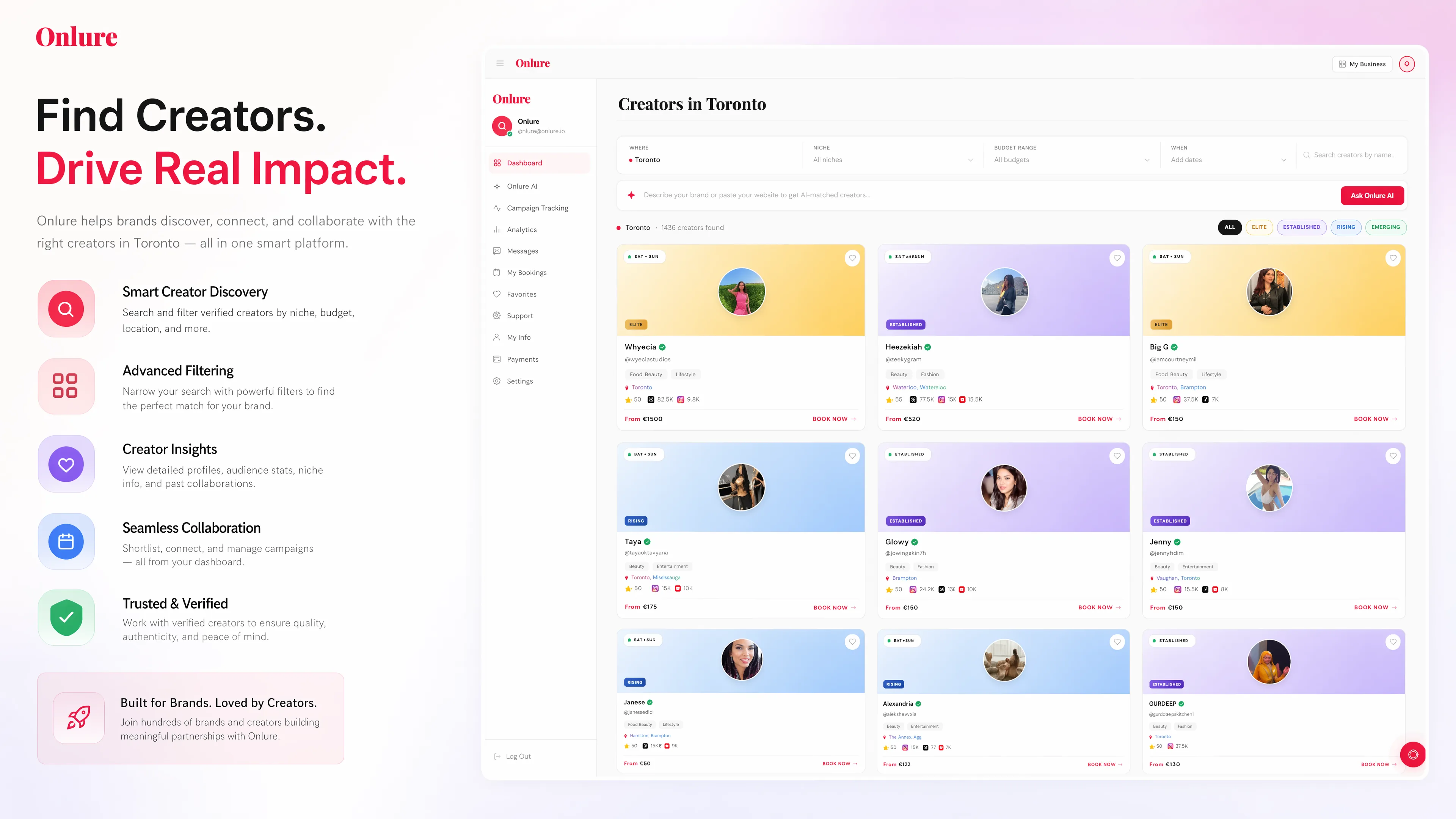
Onlure prints its prices in Canadian dollars on one pricing page. The Free plan lets a business browse creators and send one message per creator. Onlure Plus is C$29 a month, month to month, and adds unlimited messaging, an AI matcher, escrow, a Toronto-based account manager and a refund guarantee, with zero commission on the creator's fee on every plan. A campaign is priced in the builder before anyone pays: a fixed content fee per creator by tier, then performance pay at rates the product bills with, C$6 per verified walk-in from a creator, C$2 per 1,000 views, and a commission you set between 1% and 50% on online sales.
Which contract are you signing?
Grin's four self-serve plans are month to month, which suits a brand that wants to try a program for a season. Grin's custom-quoted top tier is an annual agreement. Upfluence asks for 12 months from the first invoice, so a small business is committing a year's budget before the first creator posts. Onlure Plus is a monthly subscription that can be cancelled from the dashboard, and the Free plan has no term at all; a campaign's cost is set when it is published and paid from a reserve the brand sets, so no campaign runs up an open-ended bill.
The currency matters too. Grin bills in US dollars; Upfluence shows no currency on its pricing page; Onlure bills in Canadian dollars, which means the price a Toronto business sees is the price on its statement.
What does each one measure?
Grin's pricing page describes posts "found and tracked automatically, with impressions and engagement," plus paid partnerships and affiliate commissions on every plan. Upfluence's page lists "Affiliation and discount" and "Generate & track sales" on its Scale and Autopilot plans. Both are built around online outcomes: a post went live, it was seen, a tracked order followed.
A physical business needs a third number. A customer watches a Reel on Monday and comes in on Thursday without clicking anything; Instagram records a view, the till records a sale, and nothing joins the two. Onlure has solved that for local campaigns. Each walk-in is verified in store and credited to the creator who sent the customer, so a campaign report shows the customers each creator brought in, beside views and any online sales. That is how World Soccer Party counted 173 walk-ins from seven creators and Simi African Foods counted 37 from creators and flyers. How the verification works is proprietary. It is live today for beta brands and Shopify stores; any other brand sets it up on a founder demo. Online, Onlure tracks sales through a creator's link and the store's own order record, on WooCommerce, BigCommerce, Squarespace, Wix or Stripe stores; Shopify online stores follow once Shopify approves Onlure's app.
Which one fits a Canadian small business?
Choose Grin if you already run a creator program with a marketing team, sell online and want software that finds, pays and reports on dozens of creators a month; budget the management fee on deposits, in US dollars. Choose Upfluence if you want the same at larger scale, with discovery and outreach handled inside one 12-month contract, and a demo before a price is acceptable to you. Choose Onlure if you are a local business, or an online store selling to Canadians, that wants to book a few creators at a published rate, pay in Canadian dollars with no commission on their fee, and see which creator brought each customer in or each order through. The guide to performance-based marketing explains how Onlure prices each result, and the platform comparison for small businesses covers the marketplaces and UGC tools this page leaves out.
Frequently asked questions
Is Grin free?
Grin has a Free plan at $0 a month, but it adds a 20% management fee on the money you deposit to pay creators, and the Shopify listing says a subscription is required to finish the app install. Starter is $200 a month in US dollars with a 10% fee on deposits, after a 30-day trial.
How much does Upfluence cost?
Upfluence publishes no price. Its pricing page says plans are custom-quoted by the modules you pick, that every plan is a fixed platform fee, and that the minimum contract is 12 months. There is no free plan; a free trial is set up after an initial call.
Can a business outside Toronto use Onlure?
Onlure's creator community is in Toronto and the Greater Toronto Area, so a business there has the most creators to book. A brand elsewhere can still run online-store campaigns through creator links, and should check creator coverage in its city before booking a walk-in campaign.