
Marketing attribution software ties each sale, sign-up or store visit to the marketing that caused it, so a brand can see which ads, emails and creators earn their budget. For a retail or local brand in Canada the hard part is the store: most tools see the online order and lose the customer who walks in. Here are ten tools compared on what each can see, what it costs as its own page prints it, and what it needs from you, with every price read on November 1, 2026.
In short
- Start with the free layer: Google Analytics 4 for the website, the store platform's own reports and each ad platform's conversion reports.
- Paid multi-touch tools such as Northbeam and Ruler Analytics price by ad spend or website traffic, and most are built for sales that start with a click.
- In-store sales are the job of offline attribution, and most tools go dark there: Google models store visits only above privacy thresholds it doesn't publish, and Meta matches only sales that carry a customer's details.
What does marketing attribution software do?
It joins two records that live apart: the marketing a person saw or clicked, and the sale or visit that followed. Last-click tools credit the final touch, multi-touch tools spread the credit across every touch they can see, and marketing mix models estimate each channel's share from weekly totals. Few teams join it all up: Nielsen's 2025 survey of 1,400 marketers found 32% measure traditional and digital media spend holistically. The guide to digital marketing attribution covers the terms.
1. Google Analytics 4: free, for your website
Google Analytics is "free of charge" and credits key events on your website or app to the traffic that brought the visitor, by a data-driven model or last click. A campaign shows up when its links carry UTM parameters, so a creator is visible only through a tagged link, and a store sale only if you upload it. Analytics 360, for large enterprises, prints no price: a base fee plus a per-event fee, through sales.
2. Google Ads store visit conversions: modelled visits from Google ads
Store visit conversions show "how your ads influence store visits" for Google's own Search, Display and YouTube campaigns, and Canada is on the country list. The numbers are modelled from signed-in users with location history on, then extrapolated. You need location assets, verified Business Profile locations, and enough clicks and foot traffic to clear privacy thresholds that "vary by advertiser". No price is printed for the report; you pay for the ads. Store sales measurement asks for approximately 300,000 store visits in the last 90 days.
3. Meta Conversions API: in-store sales you send to Meta
Meta calls the Conversions API its "recommended integration method for sending offline and physical store events". The store sends each sale with hashed customer details such as an email or phone number, and Meta matches it to the people its ads reached. The guide names no cost. A sale with no customer details can't be matched.
4. Shopify marketing reports: online orders by campaign
Shopify credits online store orders to the marketing behind the visit, using UTM parameters and last non-direct click by default. The reports come with the store: on Shopify's Canadian pricing page, Basic is "$49 CAD/mo" paid monthly or "$37 CAD/mo" paid yearly, and Grow is "$132 CAD/mo" or "$99 CAD/mo". Shopify's help centre says the reports summarize "Online Store channel orders", so a sale at the till isn't credited to a campaign.
5. HubSpot Marketing Hub: contacts and deals
HubSpot credits contacts and deals to the sources and interactions that produced them, with five models including its own empirical one. Attribution reports need Marketing Hub Professional or Enterprise, and deal revenue attribution needs Enterprise. The pricing page, in US dollars, starts Professional at "$800/mo" or "$890/mo" by billing option and Enterprise at "$3,600/mo", each with required one-time onboarding of $3,000 and $7,000 respectively. A till sale counts only once it becomes a HubSpot deal.
6. Triple Whale: multi-touch for Shopify brands
Triple Whale is a Shopify app for online brands. Its free plan has first- and last-click attribution, and multi-touch attribution starts with Foundation, which the Shopify App Store listing prices at "$305.26 CAD / month or $3,052.63 CAD/year", an estimate from US dollars billed in the store's own currency. The listing doesn't mention in-store or point-of-sale sales.
7. Northbeam: multi-touch for brands with large ad budgets
Northbeam sells multi-touch attribution across ad channels and prices it by marketing spend. Starter is listed at "$1,500", month to month for Shopify brands spending under $1.5 million a year on ads; Professional is "$3,500" "per month" on annual terms; Growth and Enterprise are quoted. No currency code is printed. Its documentation says offline channels "do not generate Clicks, so Northbeam can't directly attribute conversions to them".
8. Rockerbox: online and retail, matched by customer ID
Rockerbox combines multi-touch attribution, marketing mix modelling and incrementality testing, and accepts a retailer's in-store purchases by file or webhook. Each sale needs the same email or user ID as the website; without one, its help centre says, "there is no way for Rockerbox to attribute marketing touchpoints back to that user." It publishes no price.
9. Ruler Analytics: forms, calls and in-store systems
Ruler Analytics attributes forms, calls, chat, online orders and offline events, and says it can join "your in-store systems and your eCommerce platform". Its prices are "Indicative pricing", scaled to monthly website visits: Small, up to 10,000 visits a month, is from "$400" a month billed monthly or "$360" billed annually, with no currency code beside the dollar figures. Marketing mix modelling, its answer for sales with no click, is in the Advanced tier.
10. Placer.ai: foot traffic estimates from a device panel
Placer.ai estimates visits from a panel of mobile devices and says it can "prove which campaigns drove store visits" for digital, direct mail and out-of-home campaigns. Pricing is "customized subscription packages", with a freemium version. Its pages describe the panel and its estimates for the United States, and it shows no data for locations with fewer than 50 unique devices.
What can't most attribution software see?
A customer watches a creator's video on Monday and comes in on Thursday without clicking anything. Web analytics never sees the visit, a platform report models it only for its own ads, and the matching tools need an email or phone number on the receipt. Statistics Canada counted e-commerce at 7.6% of Canadian retail trade in August 2026, and a tool built on clicks starts from that slice. Closing the gap is foot traffic attribution: crediting each visit to the post, flyer or ad that sent the customer, and there are seven ways to do it.
Where does Onlure fit?
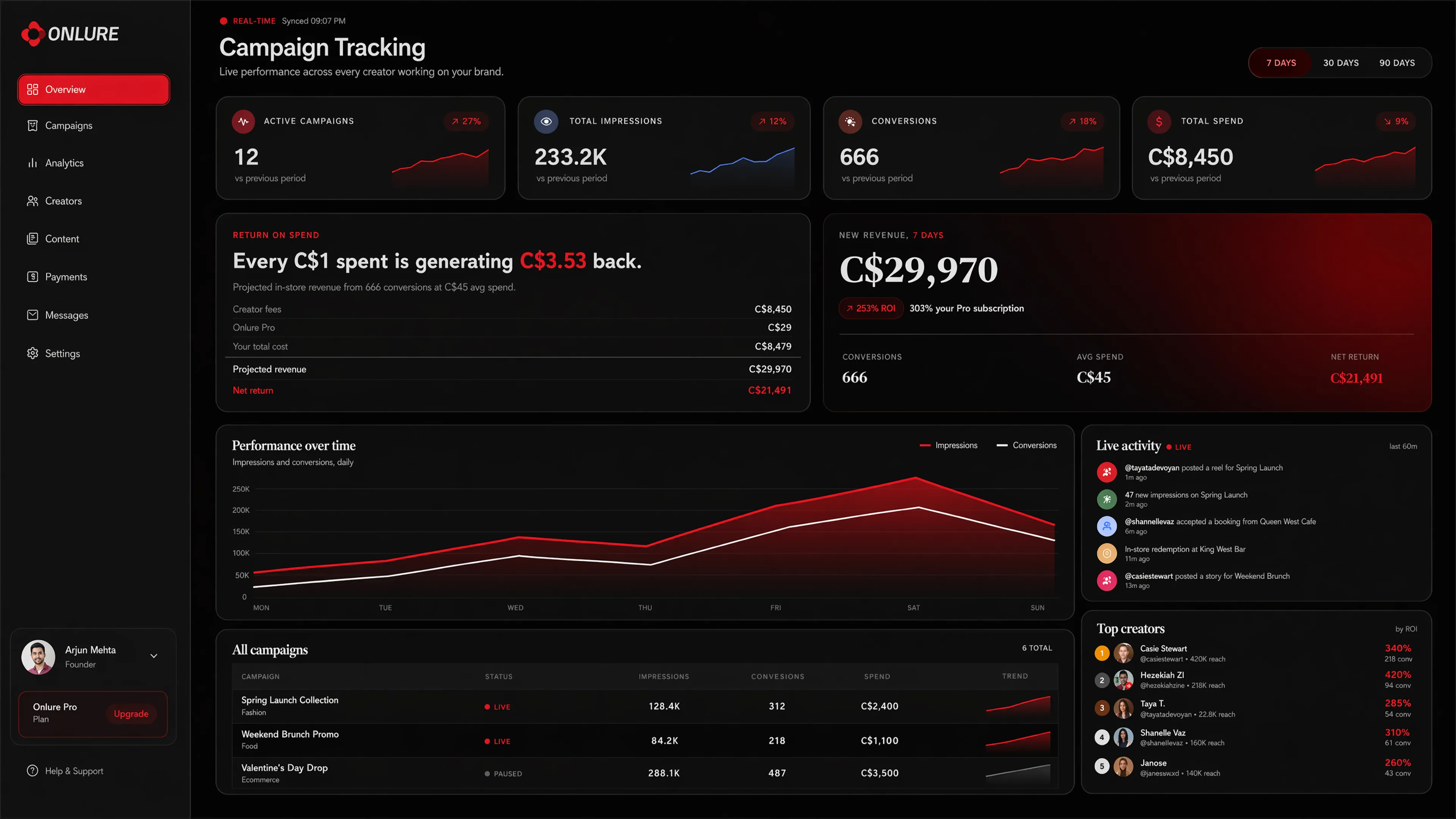
Onlure is a Toronto marketplace where local businesses book creators and pay for results, so the count comes with the campaign. The walk-in that click-based tools never see is the part Onlure has solved for local campaigns. Each walk-in is verified in store and credited to the creator who sent the customer, and a campaign reports those walk-ins next to views and any online sales. How the verification works is proprietary. It is live today for beta brands and Shopify stores; any other brand sets it up on a founder demo. Online, sales come from a creator's link and the store's own order record on WooCommerce, BigCommerce, Squarespace, Wix or Stripe stores; Shopify online stores follow once Shopify approves Onlure's app. A brand account is free, Plus is C$29 a month, and the brand pays C$6 per verified walk-in from a creator and C$3 from a flyer or static ad; the pricing page has the rest. World Soccer Party counted 173 walk-ins from seven creators on a C$1,000 budget.
Which tool should a retail or local brand pick?
- An online store with steady ad spend: start with Shopify's reports and Google Analytics 4, then add Triple Whale or Northbeam once the ad budget justifies the cost.
- A business that sells through forms, calls and a sales team: HubSpot or Ruler Analytics.
- A chain with real Google Ads volume: Google's store visit conversions, Meta's Conversions API for sales with customer details, and Rockerbox to join them with online data.
- A single store, restaurant or venue: a code per source at the counter, and campaigns that count the walk-ins each creator or flyer brings in. Placer.ai answers trend questions about a place, not which campaign sent which customer.
Frequently asked questions
What is the best marketing attribution software for a small business?
The one that sees where your customers buy. An online store can start free with Google Analytics 4 and its store platform's own reports, and add a paid multi-touch tool once its ad budget justifies one. A business whose customers walk in needs a count at the place, because web analytics and ad platforms see clicks, not visits.
Can marketing attribution software track in-store sales?
Some of it can, with conditions. Google Ads models store visits for accounts that clear its privacy thresholds, and Meta and Rockerbox match in-store sales that carry a customer's email or ID. A sale with no click and no contact details stays invisible to them, which is why a store needs its own count at the place.
How much does marketing attribution software cost?
From nothing to thousands a month. Google Analytics 4 is free, Shopify's reports come with the store plan, Ruler Analytics lists its Small tier from $400 a month billed monthly, and HubSpot's attribution reports need Professional, from $800 a month in US dollars plus onboarding. Prices were read on November 1, 2026.