
The best influencer marketing platform for a small business in Canada is the one whose measurement matches your goal. A café needs visits counted; an online store needs orders tracked; a brand building an ad library needs content at volume. The six platforms below were first compared on October 6, 2026; every price was read again from each company's own pricing page on November 22, 2026.
In short
- A café, salon or shop that wants customers through the door: Onlure, which reports the walk-ins each creator sends.
- An online store: Shopify Collabs. Content for paid ads: Insense. A free marketplace to browse: Collabstr.
- A team running dozens of creators: Upfluence, or #paid if you want the program run for you.
How do the six compare on price, contract and home base?
Home bases are from each company's own terms or contact page, read on November 24, 2026.
| Platform | Best for | Starts at | Contract | Based in |
|---|---|---|---|---|
| Onlure | Local foot traffic | Free; Plus C$29 a month | None; cancel anytime | Toronto |
| Collabstr | Browsing for free | Free with a 10% hiring fee; Pro $249 a month, billed annually | None on monthly plans | British Columbia, for Canadian brands |
| Shopify Collabs | Shopify stores | Free to install; 2.9% on commission payments | None | Ottawa |
| Insense | UGC for paid ads | $500 a month, billed quarterly, plus a 10% fee | Quarterly billing | New York |
| Upfluence | Larger programs | Custom quote | 12 months minimum | New York and Lyon |
| #paid | A managed service | No published prices | By agreement | Toronto |
1. Best for local foot traffic: Onlure
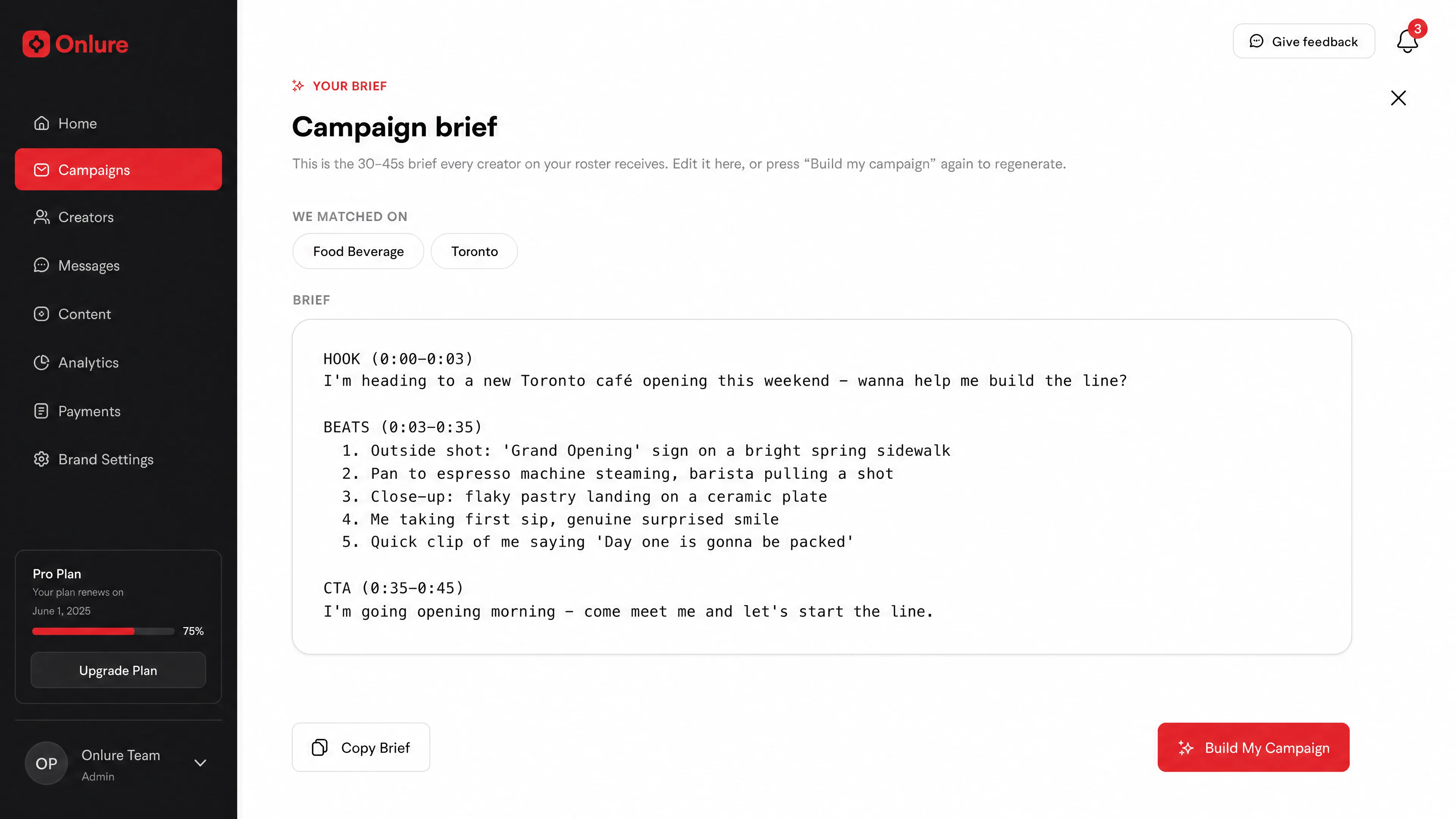
Onlure is a Toronto marketplace where local businesses book local creators. A brand account is free, with no monthly fee: you browse 2,000+ creators, draft and launch campaigns, pay per campaign and message the creators you've booked. Onlure Plus, at C$29 a month, adds messaging any creator, vetted creators who reach out to you, unlimited team seats, an account manager and campaign balance every paid month. Both plans carry a 100% refund guarantee and "zero commission, always".
The measurement is what sets it apart for a physical business: a campaign reports the walk-ins each creator sends, so the next booking goes to the creators who brought customers. Two published campaigns, World Soccer Party (173 walk-ins from seven creators) and Simi African Foods (37 walk-ins from one creator campaign), show the reports. Weakness: it is Toronto-first, so a business elsewhere in Canada should check creator coverage in its area first. The brands page explains how a campaign is set up.
2. Best free marketplace to browse: Collabstr
Collabstr's free plan is a real marketplace: search 1.3 million creators, hire from a profile, pay into escrow, with a 10% hiring fee per order. Collabstr Pro ($249 a month, billed annually) adds one campaign a month and live analytics for five posts at a time; Premium ($333 a month, billed annually) adds unlimited campaigns, 15 tracked posts and a 5% fee. Creators pay a separate 15% on their payout. Strength: scale and filters. Weakness: the reports are engagement and audience on tracked posts; nothing counts a visit. The Collabstr alternatives page goes deeper.
3. Best for Shopify stores: Shopify Collabs
If you sell online on Shopify, Collabs lets creators earn a commission on sales tracked through their links. Shopify's help centre states a 2.9% processing fee on every automatic commission payment, handled in US dollars, with an example: a $100 sale at a 10% commission carries a 29-cent fee. Strength: it is inside the store you already run. Weakness: it measures orders, and a store visit is not an order.
4. Best for UGC for paid ads: Insense
Insense sells content at volume. The self-serve plans are a Trial at $650 for the first month, Brand at $500 a month billed quarterly, and Agency at $800 a month, with a marketplace fee on creator payments of 20% on Trial, 10% on Brand and 7% on Agency. Strength: briefs, usage rights and ad-ready formats are the product. Weakness: for a single local business the subscription plus the fee outruns the budget.
5. Best for larger programs: Upfluence
Upfluence is custom-quoted by module (Find, Scale or Autopilot), with a fixed platform fee rather than a percentage of sales and a 12-month minimum contract. Every tier searches a database of 14 million creators and shows performance and audience data on each. It is the right shape for a team running dozens of creators across markets, and the wrong shape for a shop that books three. Grin is the other name teams this size weigh; Grin vs Upfluence vs Onlure sets the three side by side.
6. Best managed service: #paid
#paid publishes no prices. It describes itself as creator infrastructure for enterprise consumer brands, with briefing, sourcing, contracting, approvals, payments and measurement in one place. If you want a team to run the program for you, it is one of the names to call; if you want to see a price before you sign up, it is not.
Which platform suits a national campaign in Canada?
For a campaign that runs in several provinces, two of the six are built for it: Upfluence, with its 14-million-creator database and a 12-month contract, and #paid, which handles sourcing, contracting and payments for enterprise brands. Collabstr covers the same ground self-serve: post a campaign and creators anywhere in Canada apply with their prices. Onlure is the wrong tool for a national push today, because it runs in Toronto and the Greater Toronto Area.
Which platforms have creator discovery and audience analytics?
Upfluence has both in every tier: search across its database, with performance and audience data on each creator. Collabstr's free plan searches by niche, location and demographics, and its paid plans add engagement and audience reports (20 on Collabstr Pro, 50 on Premium). Onlure's search is by niche, neighbourhood and follower range, and its report answers a different question: how many people each creator sent through the door.
Which platform fits an in-house brand team?
It depends on the size of the team. One person running marketing for a café or a shop needs self-serve and no contract, which is Onlure or Collabstr. A Shopify store with someone who owns affiliates can run Collabs from the store's own admin. A team with a dedicated creator manager gets its money's worth from Upfluence's annual plan, and a brand with the budget but nobody to run creators is who #paid is for.
Which platform fits a mid-sized brand?
With a few people in marketing and creators in the dozens, the limits matter more than the entry price. Collabstr Premium lifts the cap to unlimited campaigns, 15 tracked posts and 50 audience reports; Insense's Agency plan, at $800 a month, cuts the marketplace fee to 7%. Past those, it is Upfluence's 12-month contract or #paid's managed program.
What changes when the campaign is Canadian?
- Where the audience lives. A creator in Toronto can have followers who are mostly elsewhere. Ask for the audience-location breakdown before you pay; a shop needs the share near the store.
- The language of the disclosure. Ad Standards says to disclose in the language of the post, so a French caption gets a French disclosure, and a brand tag alone doesn't count. The disclosure checklist has the wording.
- Cold email. An email offering a creator paid work can count as a commercial message under Canada's anti-spam law, which asks for consent, your name and contact details, and a way to unsubscribe (section 6). Consent is implied when the creator has published that address with no note refusing unsolicited messages and your message is about their work (section 10).
- Quebec. For a campaign aimed at Quebec, the Charter of the French Language says commercial advertising must be in French, alone or with French "markedly predominant" (section 58).
- Currency. Of the six, only Onlure prints prices in Canadian dollars. Interac, Stripe or PayPal covers how creators get paid here.
A summary, not legal advice; each link goes to its source.
What should you check before you pay?
- Does the platform count the thing you sell: a visit, an order or a video?
- What does it take from the creator? Creators price fees in, so a 15% or 20% cut comes out of your budget one way or another.
- Can you pay for results rather than posts? Performance-based influencer marketing pays for a visit, a sale or a view, and each platform supports a different mix.
For what to pay the creators themselves, the Toronto micro-creator pay guide has current rates, and the creator brief guide covers what to ask for. For a first campaign from start to finish, the complete guide to influencer marketing for Toronto small businesses goes through creator tiers, campaign types and a 30-day plan.
Frequently asked questions
How much does an influencer marketing platform cost in Canada?
Platform costs range from free (Onlure's Free plan, Collabstr's free plan with a 10% fee) to several hundred dollars a month (Collabstr Premium at $333, Insense Brand at $500 plus a 10% fee). Creator fees come on top; the Toronto micro-creator pay guide has rates by follower tier.
Do I need a platform, or can I message creators directly?
You can message creators directly, and many local deals start that way. A platform adds escrow, a brief, disclosure prompts and, in Onlure's case, a count of the visits each creator sends, which a direct message cannot provide.
Which influencer platforms work for businesses outside Toronto?
Collabstr, Shopify Collabs, Insense, Upfluence and #paid are location-neutral. Onlure is Toronto-first; check creator coverage in your city before booking.
Which of these platforms are Canadian companies?
Three of the six: Onlure and #paid (Hashtag Paid Inc.) in Toronto, and Shopify, which makes Collabs, in Ottawa. Collabstr contracts with Canadian brands through a British Columbia corporation. Insense is in New York, and Upfluence lists New York and Lyon.