There are seven ways a Canadian online store can track the sales a creator on Instagram or TikTok brings in: a discount code, a tracked link with GA4, an affiliate app installed on the store, an affiliate network, Shopify Collabs, a creator link tied to the store's own order record, and the shops built into the apps themselves. They differ in what they cost, who they charge, which store platforms they run on and, most of all, in which orders they miss. The prices below were read from each product's own pricing page on October 28, 2026.
In short
- Discount codes cost nothing beyond the discount, work anywhere, and leak.
- UTM links with GA4 are free and show clicks and sessions, but credit the last click and lose the customer who buys later on another device.
- Affiliate apps such as UpPromote, Refersion and GoAffPro start free and charge a monthly fee plus 1% to 3% of referred sales as they grow.
- Affiliate networks such as Awin and impact.com add publishers and a contract: Awin's US page prints $49 a month plus 3.5% per transaction, impact.com's Starter is $30 a month plus 2.5% of revenue on a 12-month term.
- Shopify Collabs is free to install on most Shopify plans, with a 2.9% fee on each automatic commission payment.
- Creator links with your store's own order record (how Onlure does it) pay the commission you set, 1% to 50%, only on orders your store itself reports.
- In-app shops keep the whole sale inside TikTok or Instagram, and keep the data there too.
1. Does a discount code count creator sales?
Yes, within limits. Give each creator a code, read the code field at checkout, and every order with the code is theirs. It works on Shopify, WooCommerce, Squarespace, Wix and anything with a coupon field, and it costs the discount and nothing else. It misses two kinds of order: the customer who saw the creator but did not type the code, and the stranger who found the code on a coupon site. Social Snowball's own pitch on its homepage is a link that mints a single-use code per click, which tells you how common the leak is.
2. What does a UTM link with GA4 show?
Clicks, sessions and, with e-commerce events set up, purchases that happen in the same session. A UTM link is free and takes an afternoon. Its blind spots are structural: the in-app browser on Instagram and TikTok often opens a fresh session, a customer who comes back tomorrow on a laptop is a new visitor, and GA4 credits whichever click came last, so a creator who started the sale loses it to the search ad that closed it. Use it to see traffic by creator, not to pay by sale.
3. What does an affiliate app on the store cost?
An affiliate app lives inside your store and issues each creator a link and a code. Three of the common ones, as their pricing pages print it:
- [UpPromote](https://uppromote.com/pricing/), built for Shopify: a Free plan, then Growth at $29.99 a month paid monthly or $24.99 a month paid yearly, plus 2% of referral sales; Professional at $89.99 or $74.99 a month plus 1.5%; Enterprise at $199.99 or $166.66 a month plus 1%. Fourteen-day trials on the paid plans.
- [Refersion](https://www.refersion.com/pricing): a free marketplace listing, then Launch at $39 a month paid monthly or $29 a month on yearly billing, plus 3% of affiliate-driven sales; Growth at $199 or $159 a month plus 2%. It integrates with Shopify, BigCommerce, WooCommerce and Magento, and tracks by first-party domain, links, codes, customer email and SKU.
- [GoAffPro](https://goaffpro.com/pricing): Hobby is free with unlimited affiliates and sales; Premium is $49 a month; Business starts at $99 a month. Plugins exist for Shopify, BigCommerce, WooCommerce, Wix, Squarespace, Square and more.
Every app above shows a dollar sign with no currency code on its website; the Shopify App Store shows Canadian-dollar estimates for the same plans at the day's exchange rate. Budget in US dollars until your statement says otherwise.
4. When is an affiliate network worth it?
When you want publishers, deal sites and larger creators who already work through a network, and you can carry a contract. Awin's US pricing page prints Access at $49 a month plus a 3.5% tracking fee per transaction with a three-month minimum term, and Accelerate from $99 a month plus 2.5%; its Canadian page prints no prices and asks you to request them. impact.com prints Starter at $30 a month plus 2.5% of revenue, available only to stores on Shopify, WooCommerce, BigCommerce, Adobe Commerce, Squarespace and a few others, with a 30-day trial; Essentials is $500 a month and the tier above it $2,500, all in US dollars, on 12-month contracts, and brands in Canada are billed in their local currency. A network is a sales channel with its own fees, not a measurement tool for three creators.
5. Is Shopify Collabs enough for a Shopify store?
For most Shopify stores, yes, to start. Collabs is free to install, available on all Shopify plans except Starter and Retail, and tracks creator sales through affiliate links or discount codes inside the store you already run. Shopify's help centre states a 2.9% processing fee on every automatic commission payment, handled in US dollars and charged in the currency of your Shopify bill, with a 30-day default holding period before creators are paid. Its limits are the ones of any code-and-link system: last-click credit, leaked codes, and nothing counted if the customer buys in person.
6. How does a creator link tied to the store's own order record work?
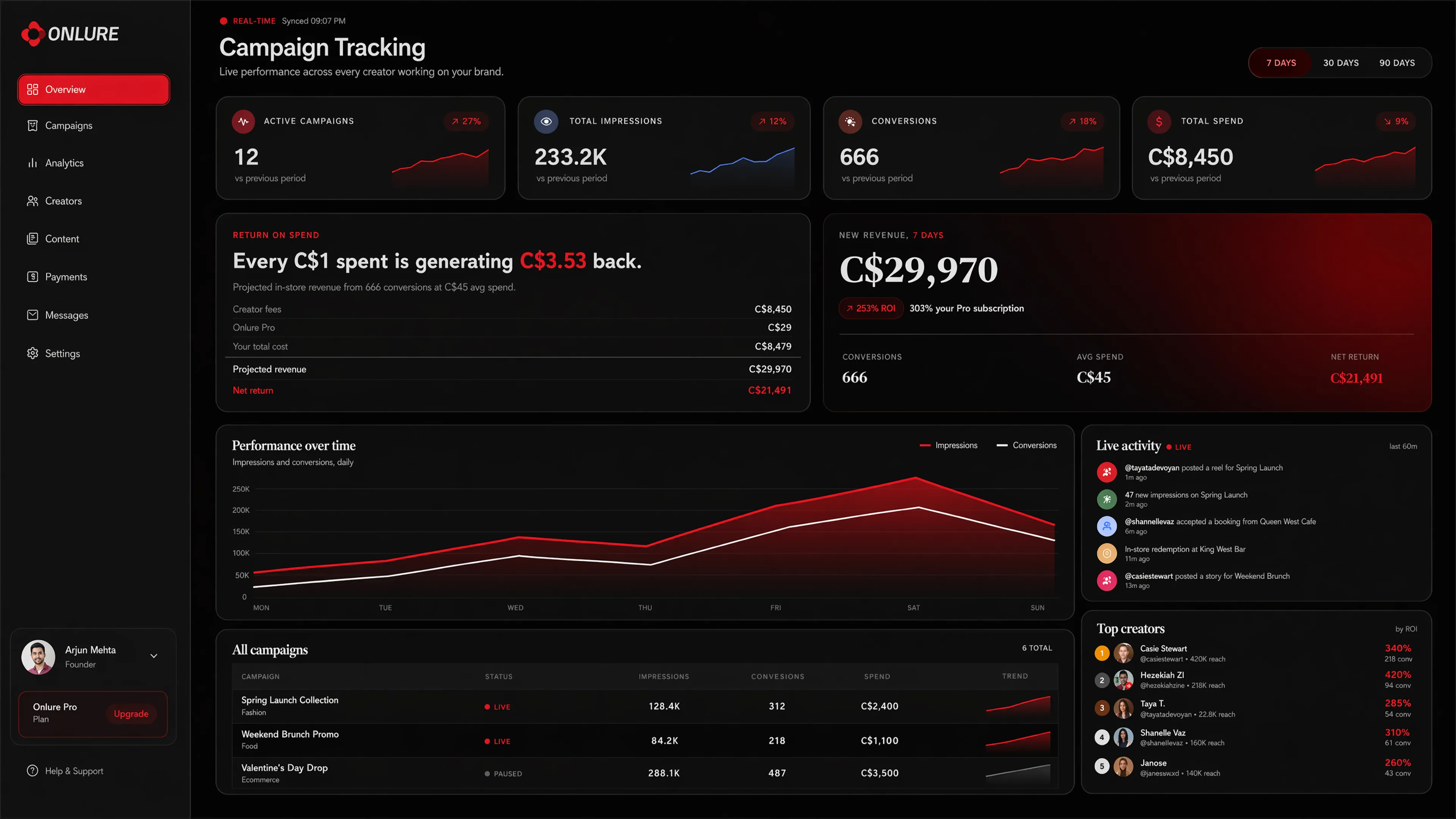
The store, not a cookie, decides what counts. On Onlure a creator shares a link made for your campaign, your store's own plugin reports the orders it records, and the creator earns the commission you set, between 1% and 50%, on those orders only. There is zero commission on the creator's content fee, and the campaign's cost is set in the builder before you publish, so the bill cannot run past the budget. It runs today on WooCommerce, BigCommerce, Squarespace, Wix or Stripe stores; Shopify online stores follow once Shopify approves Onlure's app. The same campaign can pay for in-store results and views, which is what separates it from an affiliate app; the affiliate marketing guide has the rates and the commission-based sales guide the worked examples.
7. What do in-app shops track?
TikTok Shop and Instagram's shopping tools track a creator's sale from the post to the checkout without the customer leaving the app, and pay a commission the platform manages. The count is accurate inside the app and invisible outside it: an order on your own website, a visit to your store, or a customer who saw the post and bought a week later on your site are not in that report, and the customer relationship stays with the platform. Treat it as one channel's own ledger.
Which method should a small store pick?
Start with the free layer that fits your store: a code per creator plus a UTM link, or Shopify Collabs if you are on Shopify. Move to an affiliate app when you have more creators than you can read a code report for, and to a network only when you want its publishers and can sign its term. If creators are also sending people to a physical location, or you want one campaign that pays for store visits, views and online orders at published rates in Canadian dollars, run it on Onlure and let the store's own record settle the sale. Paying creators a share of what they sell is commission-based influencer marketing, one of six performance-based influencer marketing models compared side by side. The guide to performance-based marketing covers how each result is priced.
Frequently asked questions
What is the cheapest way to track creator sales?
A creator-specific discount code costs nothing but the discount itself and works on any store. Its weakness is the orders it misses: customers who forget the code, and codes that leak to coupon sites and get used by people who never saw the creator.
Do I need an affiliate app if I sell on Shopify?
Shopify Collabs is free to install on most Shopify plans and tracks creator links and codes, with a 2.9% processing fee on each automatic commission payment. A separate app or network adds a subscription or a percentage of sales, so start with Collabs unless you need a network's publishers or cross-store tracking.
How does Onlure track online sales from a creator?
A creator shares a link made for your campaign, your store (WooCommerce, BigCommerce, Squarespace, Wix or Stripe) reports the orders it records through its own plugin, and the creator earns the commission you set, between 1% and 50%, on those orders only. Shopify online stores follow once Shopify approves Onlure's app.