TLDR: Influencer marketing in 2026 has stopped being optional for Toronto small businesses. The brands that figure out the right creator mix, pricing, and verification this year will hit 2027 with a customer acquisition channel that compounds. The brands that don't will keep paying $70+ per Google Ads lead while their competitors take their customers. This guide is the complete playbook: what works, what doesn't, what to spend, and how to measure.
This is the long one. If you bookmark a single Onlure post about creator marketing for your business, this is the one. We'll walk through what influencer marketing actually is in 2026, why it works for local businesses, how to pick the right creators, what to pay, what to ask for, how to measure ROI, and the most common mistakes that cost Toronto SMBs thousands of dollars per year.
What influencer marketing is and isn't in 2026
Influencer marketing is the practice of paying or partnering with content creators to reach their audience on your behalf. That's the textbook definition.
The reality on the ground in 2026 is more specific: it's the practice of working with local nano and micro creators (1K to 100K followers) to drive measurable foot traffic, brand awareness, and conversions for your business, in your neighborhood, with verified attribution.
What influencer marketing is not:
- It's not paying mega celebrities to hold your product
- It's not running a contest where someone reposts your post
- It's not a one-time gimmick
- It's not a replacement for having a good product
- It's not "free" because you sent the creator a free meal
The brands that succeed treat creator marketing as a steady, repeatable, measurable channel, not a magic trick.
Why creator marketing works for local businesses
Three reasons it works in 2026, in order of importance.
Reason one: trust is the new attention. Trust in TV ads sits at roughly 30%. Trust in banner ads sits at 17%. Trust in a creator a consumer follows: 69%. Trust in a local creator a consumer follows: even higher. Attention is cheap. Trust is expensive. Creators have trust. Ads don't.
Reason two: locality compounds. A creator who lives 2km from your storefront has followers who live 2km from your storefront. When they post about your business, the audience is geographically concentrated in exactly the area where your customers live. Onlure data shows creators within 5km of a brand drive 3.4x the in-store visit rate of creators outside 5km.
Reason three: verified attribution finally works. As recently as 2023, "did this creator post drive any actual customers" was an unanswerable question. In 2026, the better creator platforms can tell you exactly which campaigns drove real customers. That changes everything about how you budget the channel.
We covered the attribution shift in detail in The Death of Last-Click. Worth reading if you want the full context.
The Toronto market in 2026
Toronto is one of the most creator-dense cities in North America. Roughly 4% of adults in the city earn at least some income from content creation. There are an estimated 12,000+ active food creators in the city alone with 1K to 50K followers.
The neighborhoods with the highest creator density:
- Queen West and West Queen West
- Kensington Market
- Liberty Village
- Yorkville
- Leslieville
- The Annex and Bloor West
- King West
- Ossington
If your business sits in any of these neighborhoods, you have a 2 to 5km radius of creators who already walk past your storefront. Reaching them used to require luck. Today it requires a free signup on a creator platform.
The creator economy across Canada is forecast at $14B in 2026, with Toronto contributing over 30%. The city is leading the country in nano and micro creator paid activity. (Full data set in The Toronto Creator Economy in 2026.)
Choosing the right creator: size tiers explained
There are five practical tiers most local brands work with. Pick based on your goal and budget.
Nano (1K to 10K followers). Highest engagement rate. Most local concentration. Lowest rates ($50 to $400 per deliverable). Best for cold awareness, foot traffic, and discovery in a specific neighborhood. The single best ROI tier for cafes, restaurants, and small retailers under $500/month budget.
Micro (10K to 100K followers). High engagement, broader local reach. Mid-range rates ($200 to $1,500 per deliverable). Best for brands ready to scale beyond a single neighborhood, salon and fitness verticals, and any campaign needing professional content quality.
Mid (100K to 500K followers). Moderate engagement, regional reach. Higher rates ($1,500 to $5,000). Best for brands looking to reach the entire GTA, premium retail, or high-ticket service businesses.
Macro (500K to 1M followers). Lower engagement, national reach. Premium rates ($5,000 to $15,000). Best for brands with national distribution, less useful for single-location local businesses.
Mega (1M+ followers). Lowest engagement (often under 1.5%), national or international reach. Premium rates ($15,000+). Almost never the right choice for a Toronto small business.
For 90% of Toronto SMBs, the right tier is nano + micro, with most of the budget weighted toward nano.
How to pick within a tier
Once you've picked your tier, the qualifiers that matter:
- Niche match. A food creator for a restaurant. A fitness creator for a studio. A beauty creator for a salon. Cross-niche works rarely and only with strong creative direction.
- Location. Within 5km of your business is ideal. Within 10km is acceptable. Beyond that, conversion drops.
- Engagement quality. Save and share rates matter more than likes. Look for 3%+ save rate on Reels.
- Past campaign performance. Have they delivered for similar businesses before? Onlure shows past campaign completion and rating on every profile.
- Content style fit. Their last 9 to 12 posts should look like content you'd want associated with your brand.
We covered this in detail in Why Follower Count Is the Worst Way to Price a Creator.
What to pay: the rate cheat sheet
The full breakdown lives in How Much Should You Pay a Toronto Micro-Creator, but the cheat sheet:
- Single Instagram Story: $50 to $250
- Instagram Reel: $200 to $800
- TikTok video: $200 to $700
- In-store visit + multi-platform package: $350 to $1,500
- Multi-platform full package: $600 to $2,500
Add 25% to 40% if you want content licensing rights to repost the creator's work in your own ads or website.
The biggest mistake on rates: trying to negotiate a nano creator down from $200 to $100. Save the energy. Either pay the market rate or move on. Underpaying nano creators damages the relationship and the deliverable quality.
Campaign types that actually work
Five formats Toronto SMBs should know:
One: in-store visit content. The creator visits, films, posts. Highest foot traffic ROI. Requires a clean, well-lit space and a manager who's prepared for the visit. Cost: $350 to $1,500.
Two: product seeding. You send the creator a product or service in advance, they review it on their channels. Lowest foot traffic but highest content volume. Best for retail. Cost: product cost + $0 to $300.
Three: ambassador programs. A creator commits to 3 to 6 posts over 3 months for a discounted total rate. Builds repeated exposure. Best for fitness, beauty, and recurring-purchase categories. Cost: 25% to 40% discount on standard rates in exchange for commitment.
Four: content licensing only. Creator makes content for you to use in your own ads. They don't post it. You get a high-quality asset for a fraction of an agency's price. Cost: $200 to $1,000 per asset.
Five: discount drop campaigns. Creator distributes a unique discount or freebie. Customers redeem in-store. Verified attribution built in. Best for measuring ROI. Cost: creator fee + funded incentive.
How to measure ROI without lying to yourself
The single biggest pitfall in creator marketing is bad measurement. Brands either claim impossible ROI ("everyone who walked in this week was from the post!") or zero ROI ("nobody mentioned the post"). Both are wrong.
The measurement framework that works:
Step one: pick one primary metric per campaign. In-store visits, online orders, signups, redemptions. One. Not three.
Step two: instrument it. Use a unique discount code or trackable redemption mechanism. Something you can count.
Step three: count for 14 days. Most creator campaigns deliver visits over a 7 to 14 day window, not in 24 hours like an ad.
Step four: compare to a baseline. What was your normal foot traffic in the same period last month, last year? Net new visits over baseline is the real number.
Step five: run 3 campaigns minimum before judging. Single campaigns are noisy. Patterns emerge by campaign 3.
Onlure handles the measurement layer for steps 2 and 3 automatically. The platform reports the in-store visit count per creator per campaign in your dashboard, so you can compare campaigns side by side without setting up tracking yourself.
The full case for why last-click attribution doesn't work is in The Death of Last-Click.
The 5 most common SMB mistakes
We see these every week.
Mistake one: paying for follower count. A 100K-follower creator with 1% engagement and 20% local audience converts worse than a 5K-follower creator with 6% engagement and 80% local audience. Don't pay for followers, pay for fit.
Mistake two: writing vague briefs. "Just post about us!" is not a brief. A real brief names the menu item / service / product, the angle, the visit window, and the deliverable. Briefs that include all four convert at 2x the rate of vague briefs.
Mistake three: judging campaigns at 24 hours. Creator content compounds over 7 to 14 days. Brands that pull the plug after 3 days kill their own campaigns.
Mistake four: skipping content licensing. A great creator post can be repurposed as your highest-converting Instagram ad for the next 6 months. Always negotiate licensing for an extra 25% to 40%. The math is overwhelming.
Mistake five: trying to do it without a platform. Cold-DMing creators has a 2% to 5% response rate. Platform inbound has a 25% to 40% response rate. The math here is also overwhelming.
Your 30-day getting started plan
A clean 30-day plan to launch your creator marketing channel:
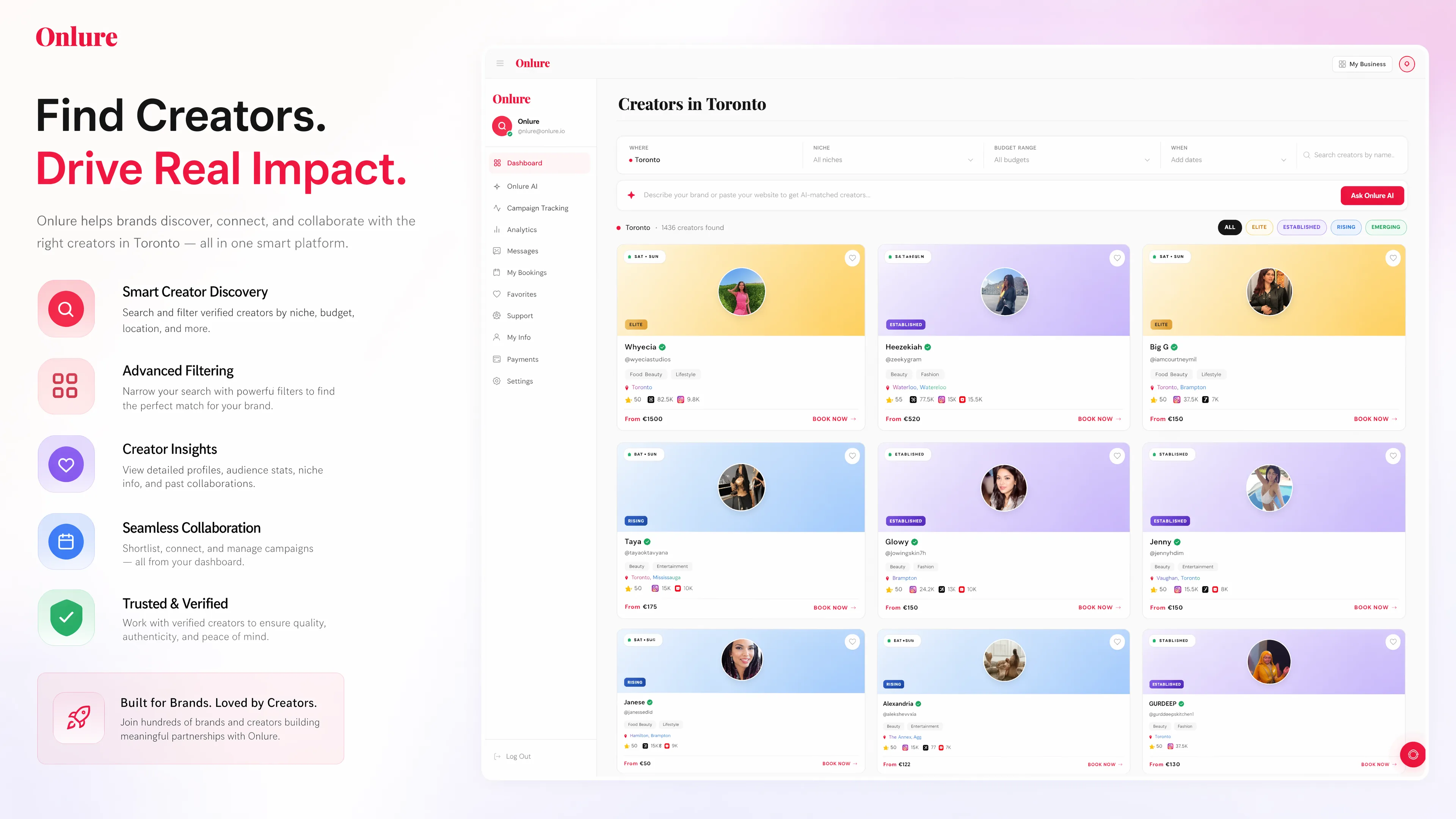
Week 1. Sign up free on Onlure as a brand. Complete your profile. Set your budget. Identify 5 creator profiles in your niche and neighborhood. Use the Agentic Creator Finder to surface a shortlist.
Week 2. Reach out to 3 creators. Send them a complete brief: who you are, what you offer, what deliverable you want, what timeline, what budget. Aim for 2 confirmed bookings.
Week 3. Run 2 campaigns. Provide everything the creator needs (menu items, talking points, visit time slots, photo permissions). Be responsive to questions. Don't micromanage the creative.
Week 4. Review results. Count verified visits, redemptions, or whatever your primary metric was. Compare against baseline. Decide which creator(s) to rebook.
By day 60, you should have 3 to 5 campaigns under your belt and a clear sense of which creators convert for your business. By day 90, this is a real channel in your marketing mix.
FAQ
Do I need to be in Toronto for Onlure to work for me? Onlure currently focuses on Toronto and the GTA. Multi-city expansion to Vancouver, Montreal, and Calgary is on the 2026 roadmap.
What if I'm not happy with a booking? Onlure offers a 100% satisfaction guarantee on all bookings. If you're not satisfied, the booking is reimbursed.
How long does it take to book a creator? The median booking on Onlure goes from creator match to confirmed booking in under 48 hours. Compare this to 21 days through an agency.
Do I need to pay a subscription? No. Onlure is free to use. Onlure Plus is C$29/month and unlocks additional features, but the core platform (browsing, messaging, booking) is free.
Can creators see my business profile before I message them? Yes. Creators can see basic info on your business profile and decide whether to respond. Most creators respond within 14 hours.
Get started
You've read 3,500 words on creator marketing in Toronto. The fastest way to act on it is to sign up free as a brand and book your first creator this week.