Canadian restaurants are paying more for food and labour, selling slightly less in real terms, and closing in the hundreds. When a dollar of marketing has to come back as a cover the same week, the question an operator asks any channel has changed. It is no longer "how many people saw it?" It is "how many people came in, and can you show me?"
In short
- 44% of Canadian restaurants were operating at a loss or breaking even in Restaurants Canada's Q4 2025 survey, and real foodservice sales are forecast to fall 1.1% in 2026.
- Dalhousie's Agri-Food Analytics Lab now expects a net loss of 1,500 to 2,500 restaurants in 2026, down from its January forecast of 4,000, with 579 closures already tracked in the first half, as Retail Insider reported in August.
- Full-service operators still describe themselves as optimistic (82% in TouchBistro's 2026 survey of 600 of them), which is why the money is moving rather than stopping.
- The channels that survive are the ones that can show a visit.
How thin are the margins?
Restaurants Canada's Q4 2025 survey, published February 12, 2026, found that 60% of operators had a worse year than they expected, 46% expect 2026 to be worse again, and 44% were operating at a loss or breaking even, up from 41% in June 2025. Quick-service operators were hit hardest: 77% reported weaker-than-expected profitability, against 58% of full-service operators. Food costs are a top concern for 88% and labour costs for 89%.
The association expects real commercial foodservice sales, after inflation, to have grown 2.4% in 2025 and to decline 1.1% in 2026. Nominal sales keep rising because prices do: Statistics Canada's February 2026 release put food services and drinking places sales at $8.8 billion, up 0.6% on the month, with full-service restaurants up 1.4% and menu prices 7.8% higher than a year earlier. More dollars, fewer plates.
The closures followed. Dr. Sylvain Charlebois's Agri-Food Analytics Lab forecast in January 2026 that Canada would lose roughly 4,000 restaurants on a net basis this year, citing cost trajectories, balance sheets, and Canadians eating out less and drinking less when they do. By August the lab had revised the figure to 1,500 to 2,500 net closures, with 579 logged in the first six months. Accommodation and food-service insolvencies reached 360 in the first half of 2026, about 7.5% more than a year earlier, and second-quarter filings rose nearly 19%.
Why did impressions stop making sense?
At a 3% or 4% margin, a C$300 ad spend has to produce several thousand dollars of sales to pay for itself, and the operator has no way to know whether it did. An impression is a promise. A view is a promise. A cover is money.
Operators are not spending less on reaching people; TouchBistro's survey of 600 full-service operators, run October 2 to 25, 2025, found the vast majority active on Facebook, Instagram and TikTok and maintaining websites. What they are doing is attaching a count to it. The same survey found that online ordering raised overall sales by an average of 18% for the restaurants that added it, which is the kind of number an operator can see on a Monday. 29% named food and inventory costs as their single biggest financial strain, and 79% said tariffs had made inventory harder, so the appetite for unmeasured spend is low.
The shift is visible in how channels get judged. A Toronto cost comparison of Google Ads against local creators came down to one number: what each channel cost per customer who actually arrived. The foot traffic guide explains why Meta and Google cannot see a small restaurant's walk-ins in the first place, and the cost per visit explainer gives the formula operators are using instead.
What a walk-in is worth
The restaurants that are growing in this market treat the visit as the unit. Simi African Foods, a Toronto grocer, ran one creator campaign on a C$500 budget, counted 37 walk-ins, and sold out a weekend at three times its usual sales; the case study has the breakdown. World Soccer Party counted 173 walk-ins from seven creators on C$1,000.
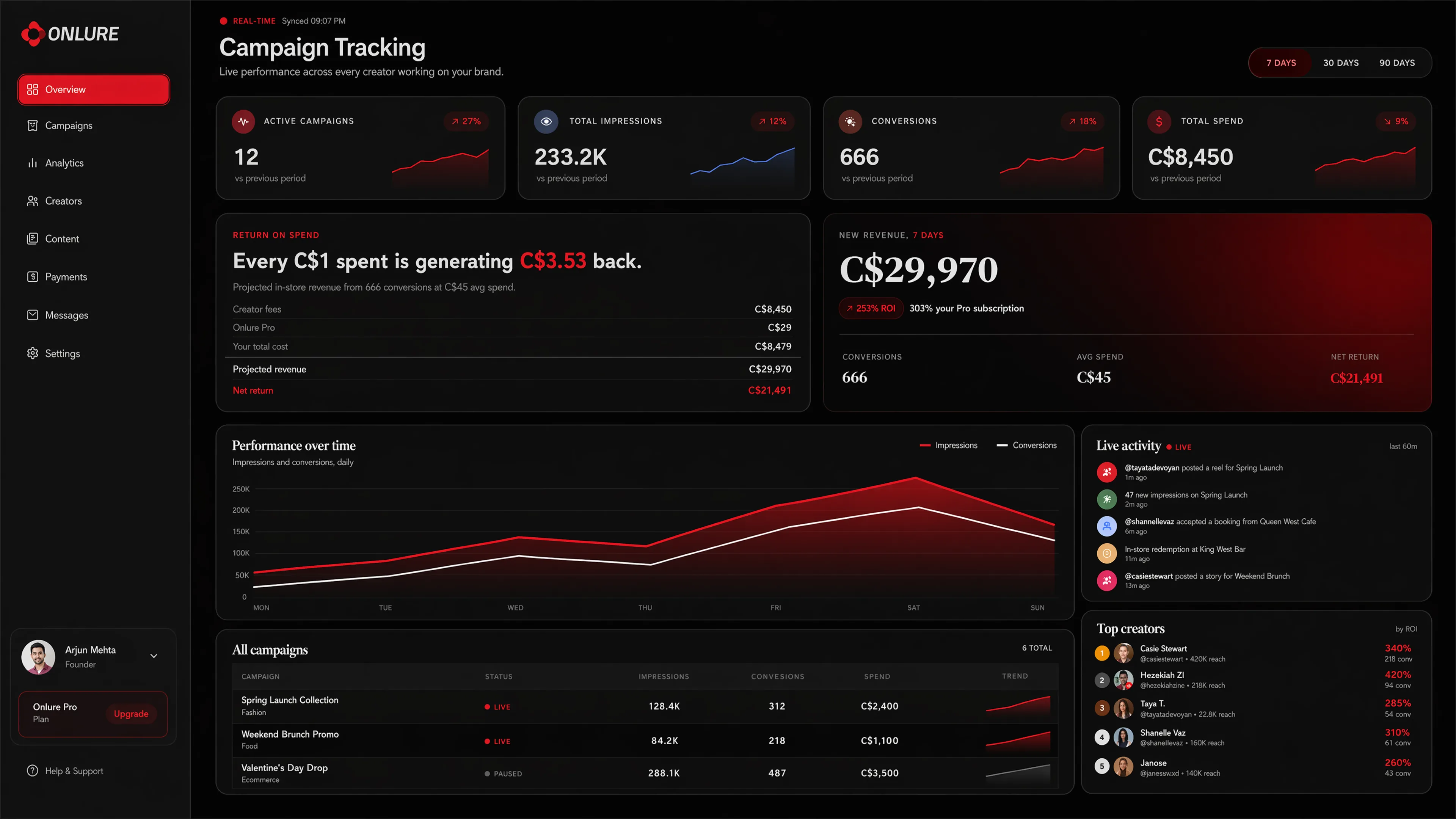
On Onlure, local businesses book local creators for a campaign and see the walk-ins each creator sends. That is the whole proposition, and in a year when 44% of restaurants are at break-even, it is the question every channel should be able to answer. The brands page explains how a campaign is set up.
What to ask any marketing channel in 2026
- Can you show me the customers, not the audience?
- What did each one cost?
- Can I stop paying the moment it stops working?
- Who sent them, so I can book that person again?
A channel that answers all four gets the budget this year. One that answers none of them is asking a break-even restaurant to take it on faith.
Frequently asked questions
What is the average restaurant profit margin in Canada in 2026?
Restaurants Canada does not publish a single average, but its Q4 2025 survey found 44% of restaurants operating at a loss or breaking even, and 60% reporting worse profitability than they expected. Quick-service operators were the most squeezed, with 77% below expectations.
How many restaurants will close in Canada in 2026?
Dalhousie's Agri-Food Analytics Lab forecast roughly 4,000 net closures in January 2026 and revised that to 1,500 to 2,500 by August, with 579 closures tracked in the first half of the year.
Why are restaurants moving marketing budgets to foot traffic measurement?
Because margins are too thin to pay for impressions on faith. With 44% of operators at break-even, a channel has to show which customers it brought in and what each one cost, or it loses the budget to one that can.