
You boosted the post. Reach looked great. The store was busier. But when you open Meta's dashboard, there's no line item that says "12 people walked in because of this." That blind spot isn't a settings problem. It's structural.
Why the platforms can't see your door
Meta and Google were built to measure online actions: clicks, add-to-carts, checkouts. When the conversion happens in the physical world, the chain breaks. After Apple's App Tracking Transparency and the decay of third-party cookies, even the online half of that chain is weaker than it used to be.
For a restaurant, salon, or boutique, the most valuable outcome is a real visit. That's exactly the one the ad platforms are worst at counting.
The cost of guessing
When you can't measure foot traffic, two bad things happen.
- You over-credit whatever is easy to track (usually a final Google search) and under-credit the creator post that actually sparked the visit.
- You can't tell your best channel from your worst, so budgets drift toward vanity metrics.
This is why half of marketing leaders cite measurement as their top influencer-marketing challenge (Later, 2026).
The fix: measure visits, not impressions
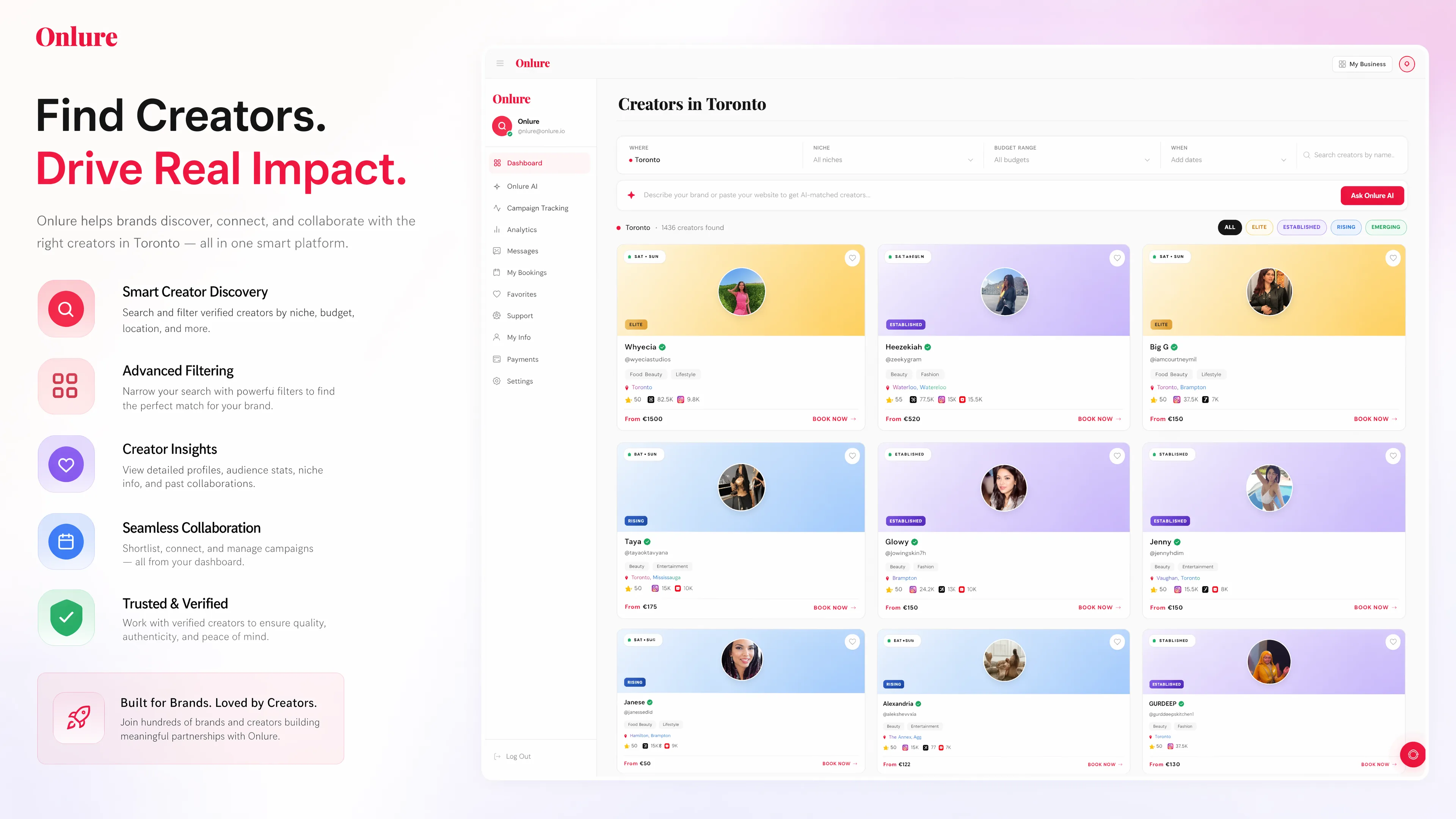
Capture the visit deterministically. Book a collaboration, then tie a scan or code at the point of visit to a specific creator and a specific outcome. That's the model creator marketplaces like Onlure are built on. The collaboration is booked through the platform, so attribution starts at the source instead of being reverse-engineered from decaying signals.
“If a channel can't prove a walk-in, treat its ROI claims as a hypothesis, not a result.”
The takeaway
Your foot traffic isn't invisible because you're doing something wrong. It's invisible because the big platforms were never built to see it. Pick tools that measure the outcome you actually care about.