
For Canadian creators in 2026, the answer is "both, but for different reasons." TikTok gives you faster discovery and audience growth with lower per-follower brand spend. Instagram grows slower but pays 2x to 4x the average brand deal. So build on TikTok, monetize on Instagram, and port content between the two. Here's the data, the differences, and the tactical playbook.
You've got the next 90 days of effort to spend, and you're deciding where to put it. For a Canadian creator, the TikTok-versus-Instagram call is real and it costs you if you get it wrong. The two platforms have split apart in 2026. Their audiences behave differently, their algorithms reward different things, and brand spend per follower differs by 2x to 4x.
This is the long version, covering where the platforms compare, where to build, where to monetize, and how to run both at once.
The 2026 Canadian creator platform landscape
Three platforms pay Canadian creators: Instagram, TikTok, and YouTube. YouTube is a different animal (long-form, search-based, its own monetization model), so we'll set it aside. This post is about the Instagram-versus-TikTok decision, because that's the one most nano and micro creators actually have to make.
The headline numbers in Canada in 2026:
- Instagram monthly active users in Canada: ~21M
- TikTok monthly active users in Canada: ~13M (rapidly growing)
- Average daily time spent on TikTok by Canadian Gen Z: ~95 minutes
- Average daily time spent on Instagram by Canadian Gen Z: ~52 minutes
- Brand creator spend on Instagram in Canada 2026: ~$5.8B
- Brand creator spend on TikTok in Canada 2026: ~$2.3B and growing fastest
The pattern is clean. TikTok wins on time spent and growth velocity. Instagram wins on raw audience size and brand spend. They serve different parts of a creator career.
Where each platform wins on discovery
TikTok's algorithm cares about the content, not your follower count. A first post from a brand-new account can hit 50,000 views if it's sharp. The For You Page is genuinely meritocratic, and discovery for new creators runs an order of magnitude faster there.
Instagram in 2026 plays favorites with creators who already have engagement. New accounts stall around 200 to 400 followers and have to grind through it. Reels can break out, but the path is steeper. Instagram has quietly become the place where established creators consolidate an audience, while TikTok is where new creators build one.
Going from zero to 5,000 followers, TikTok is faster. From 5,000 to 50,000, the two are roughly even. From 50,000 to 500,000, Instagram is the more reliable bet.
Where each platform wins on monetization
Brand spend per follower is the number that decides your income, and it tilts hard toward Instagram.
Average brand deal sizes for Canadian creators in 2026:
- Instagram Reel, 5K-10K followers: $200 to $500
- TikTok video, 5K-10K followers: $100 to $300
- Instagram Reel, 50K-100K followers: $1,000 to $3,000
- TikTok video, 50K-100K followers: $500 to $1,500
The gap comes down to age and budgets. Instagram is older, and brands have bigger creator-marketing line items earmarked for it. TikTok spend is climbing faster but off a smaller base. It closes a little every quarter. It hasn't closed yet.
Usage matters too. Brands that run creator content as organic plus paid amplification (the highest-value licensing tier) lean overwhelmingly toward Instagram. The asset they actually want is a Reel they can push as an ad. Most paid amplification lives on Meta, so Instagram-native content slots right into the brand's workflow.
Where each platform wins on engagement
TikTok posts higher engagement rates per video but burns out faster. A great TikTok hits hard for 48 hours, then it's gone. A great Instagram Reel keeps pulling saves, shares, and inbound for weeks.
If a brand is measuring "did this drive in-store visits over 14 days," the half-life of an Instagram Reel is the whole point. If a brand wants "did this go viral and reach a million people in 24 hours," TikTok takes it.
Saves are the engagement metric that actually predicts conversion. Instagram saves turn into in-store visits at 6% to 14%. TikTok saves convert at 4% to 9%. The difference is intent: Instagram users save because they plan to act later, while TikTok users save more as a bookmark for content they liked.
What this means for your strategy
Here's the play that works for most Canadian nano and micro creators in 2026.
Use TikTok for top-of-funnel growth. Post 4 to 7 times per week. Test angles, hooks, formats. This is your audience-building engine.
Use Instagram for monetization. Repost your best TikToks as Reels with light edits. Keep a clean grid that brands will browse before they book you. This is your storefront.
Port content across platforms. A TikTok at 50K views can go up as an Instagram Reel within 48 hours and pull another 10K to 30K. A strong Instagram Reel can be reformatted for TikTok and reach a fresh audience. Most creators leave 30% to 50% of their reach on the table by skipping this step.
Brand-tag on Instagram first. Brands hunting for creator collabs in Toronto check Instagram before anything else. Make your bio, your niche, and your city obvious there.
Six platform-specific rules worth knowing
Six rules, pulled from working with hundreds of Canadian creators.
Rule one: TikTok captions can be short. Instagram captions should run longer. TikTok puts video and audio first, so captions ride in the back seat. Instagram still rewards captions that drive comments and saves. Write 80 to 150 words on Instagram. Write one or two lines on TikTok.
Rule two: TikTok hooks land in the first 1 to 2 seconds. Instagram gives you 3 to 4. TikTok viewers swipe on instinct. Instagram viewers cut you a little more slack. Build the open accordingly.
Rule three: TikTok rewards trends. Instagram rewards consistency. Jump on the right trending sound on TikTok and you can hit 500K views. Post the same niche format weekly on Instagram and you build the kind of audience brands want to book.
Rule four: Instagram Stories are sleeper monetization. Most creators sleep on Stories. Brands pay $50 to $250 per Story for nano creators. Run 3 to 5 paid Story placements a week and you've got steady recurring revenue.
Rule five: TikTok Shop is real, but not for most creator types. TikTok Shop has grown, but it's concentrated in beauty, fashion, and consumer electronics. For local Toronto creators in food, fitness, and lifestyle, TikTok Shop isn't the move. Brand collabs are.
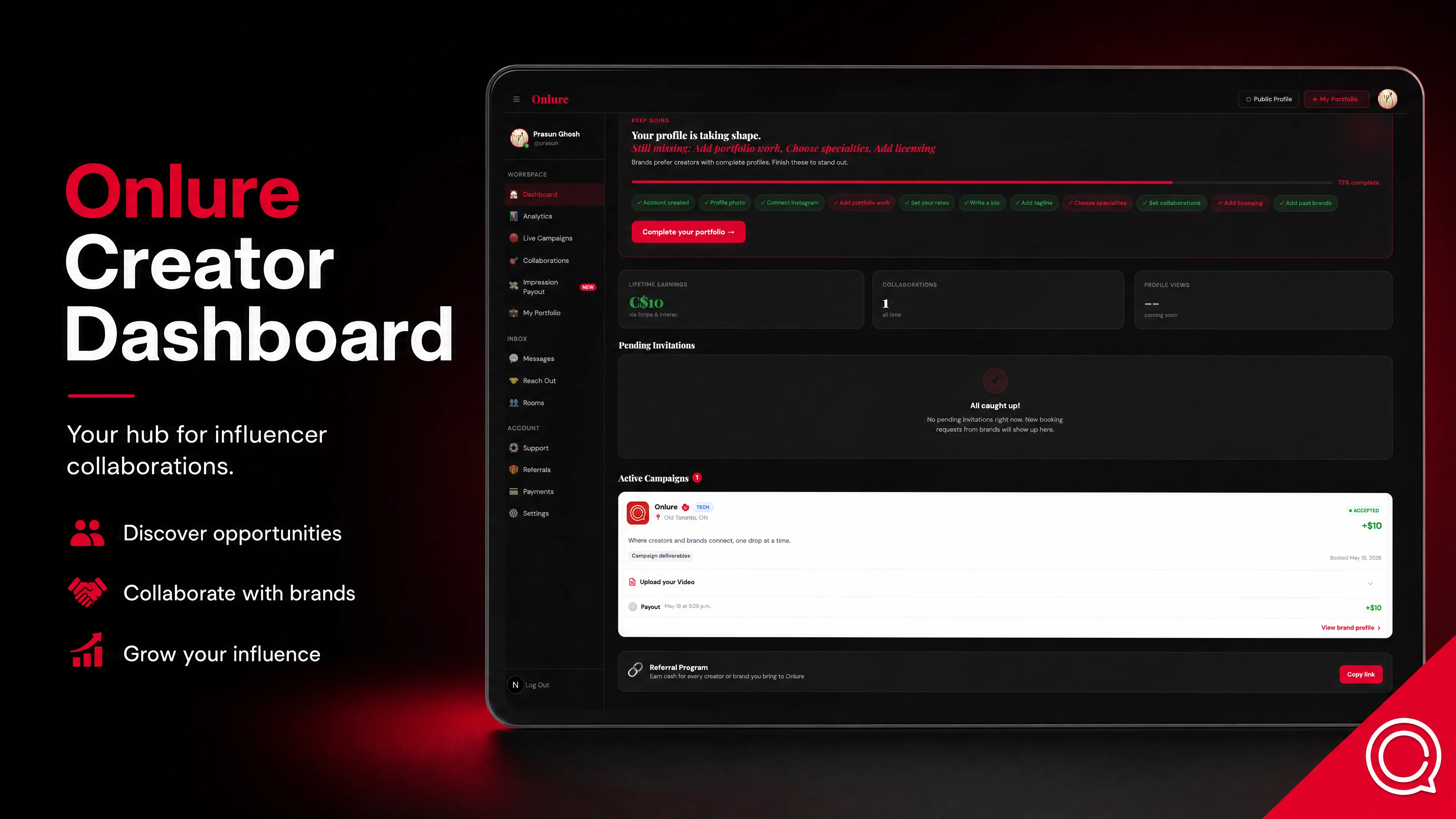
Rule six: cross-platform analytics are scattered. Every platform hands you different metrics in a different format. Use one tool that aggregates them (Onlure gives you free aggregate analytics across Instagram, TikTok, and YouTube). Skip that and you'll burn an hour a week comparing screenshots.
When TikTok is the right primary platform
For a small slice of creators, TikTok should be the main play.
- You're under 25 and your audience is under 25. TikTok owns that demo. Build there first.
- Your niche is heavily trend-driven. Comedy, dance, viral challenges, prank content. This is TikTok's home court.
- Your content is built to go viral once and vanish. TikTok was made for that. Instagram wasn't.
- You'll trade lower per-deal brand revenue for faster audience growth. Some creators happily make that swap.
For most local Toronto creators in food, lifestyle, beauty, and fitness, TikTok is the secondary platform and Instagram is primary. The brand-spend math says so.
When Instagram is the right primary platform
For most Canadian nano and micro creators, Instagram is primary.
- Your niche is local (Toronto food, Toronto beauty, Toronto retail). Local brand spend pools on Instagram.
- Your audience skews 25-45. That demo over-indexes on Instagram.
- You want predictable monthly brand revenue. Instagram is the steadier income channel.
- You eventually want content licensing revenue. Brands license Instagram-native Reels at 2x to 4x the rate of TikTok-native videos.
The real decision tree is rarely "Instagram or TikTok." It's "Instagram primary plus TikTok for growth," or the reverse.
The next 90 days
A simple 90-day plan for splitting your effort:
- Days 1-14: Audit your current numbers on both platforms. Engagement rate, follower growth, save rate, brand inquiries received. Whichever has the better trajectory becomes your primary.
- Days 15-45: Post 3x per week on primary, 2x per week on secondary. Cross-post your best work from primary to secondary.
- Days 46-75: Test which formats convert best on each. Lean into what works.
- Days 76-90: Reach out to brands on whichever platform pulled the most inbound. Land your first or next paid deal.
Most creators land their first or next paid deal in days 60 to 90 if they keep at it.
Build on both, monetize on Onlure
Onlure brand profiles surface creators across Instagram, TikTok, and YouTube at the same time. Your audience numbers from all three show up in one profile. Brands see the full picture instead of a single channel.