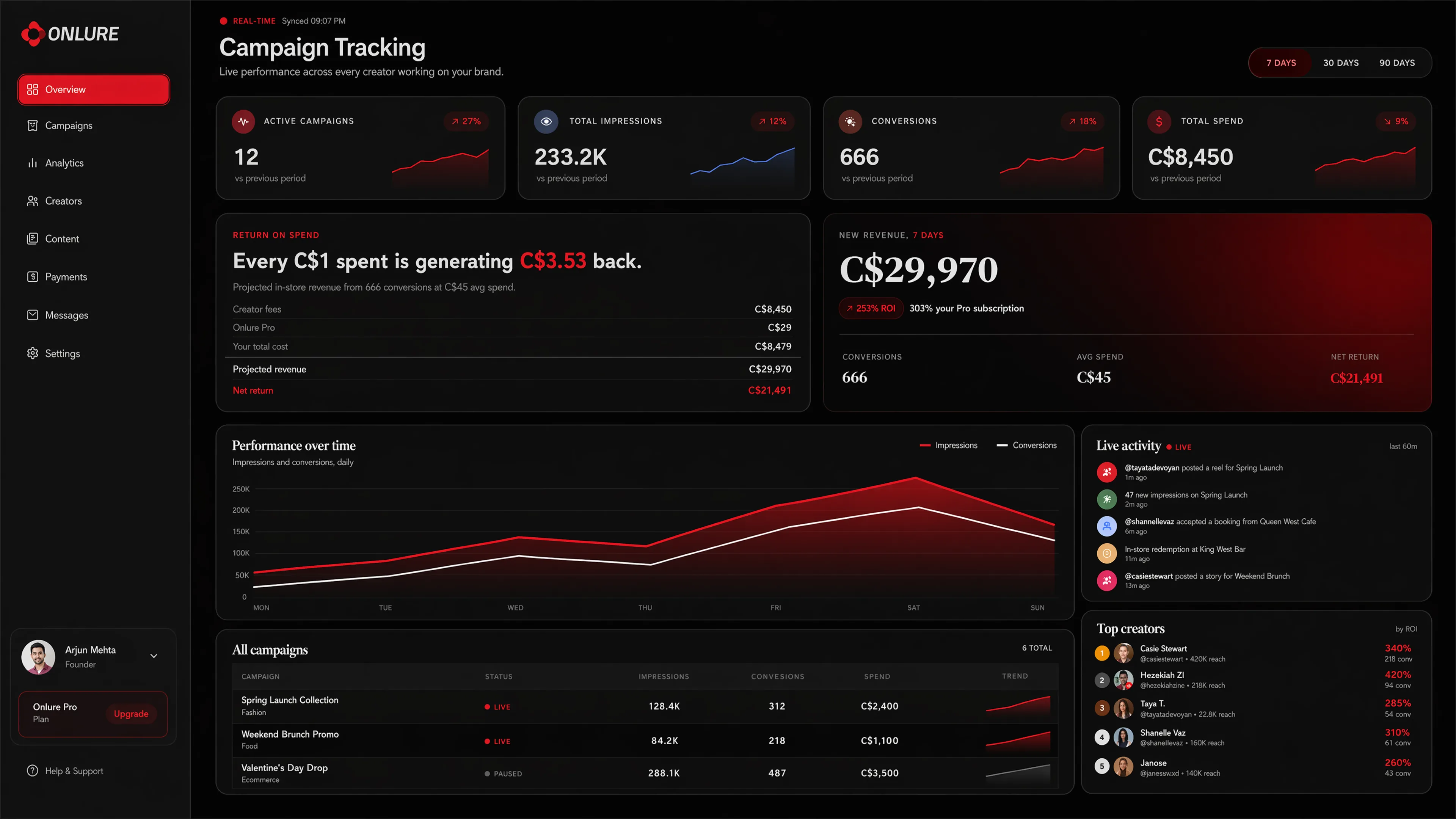

Most small businesses that try creator marketing for the first time give up at week 4 because the data is noisy and they are not sure what they are looking at. The brands that get to repeatable ROI follow a 90-day structured framework: 30 days of testing, 30 days of optimization, 30 days of compounding. Most see clear ROI by day 60 and recurring ROI by day 90. Here's the exact framework, week by week.
The biggest reason small businesses abandon creator marketing is impatience. They run one campaign, see noisy results, conclude it does not work, and go back to Google Ads. Three months later their CAC has climbed another 15% and they are still wondering what to try next.
Creator marketing has a longer feedback loop than paid ads. Single campaigns are noisy. Patterns emerge by campaign three. Repeatable ROI shows up around day 60 to 90 for most local businesses. The brands that stick with it through the noisy phase are the ones who own the channel for the next 5 years.
This is the 90-day framework that gets you from your first $300 spend to a repeatable acquisition channel. Week by week.
The framework at a glance
Days 1 to 30: Test phase. 3 creator bookings. Goal: learn the channel, get baseline data, identify what works in your niche.
Days 31 to 60: Optimize phase. 3 to 5 creator bookings. Goal: rebook the formats and creators that worked, eliminate what did not.
Days 61 to 90: Compound phase. 4 to 6 creator bookings. Goal: build a repeatable monthly cadence, license top-performing content for paid amplification.
By day 90, most businesses have a clear sense of which creators to keep working with, what content formats convert, what their cost per visit looks like, and how to forecast monthly creator marketing spend.
Total budget for the 90 days at the low end: $1,500. At the medium end: $3,500 to $5,000. At the higher end: $7,500.
Phase one: Days 1 to 30 (Test)
Week 1: Setup
Sign up free as a brand on a creator platform. Complete your profile fully (location, niche, business description, photos). On Onlure, profile completion under 70% reduces the creators willing to respond by roughly half.
Pick your first deliverable type. For most local brands, the right starter is one Instagram Reel + one set of Stories from the same creator. Cost range: $250 to $450 per booking.
Set up your tracking method. The simplest version is a unique discount code per creator. "AVA15" for Ava, "JAY15" for Jamie, etc. Track redemptions over the next 21 days. This is your attribution layer.
Week 2: First booking
Identify and book your first creator. Use the structured brief framework from our brief writing guide. Send the brief, schedule the visit, confirm the unique discount code is loaded into your POS or ordering system.
The visit itself takes 60 to 90 minutes. The post goes live within 5 to 7 days. Track redemptions starting day 8.
Week 3: Second booking + first data
Book creator number two. Different niche fit, different neighborhood, similar deliverable. By the end of week 3, your first creator's post has been live for ~7 days. You have early redemption data. Note it but do not over-interpret yet.
Week 4: Third booking + comparison
Book creator number three. Different deliverable mix this time (try a TikTok video, or an in-store visit + multi-platform package).
By end of week 4, your first creator post has been live for ~14 days. Compare the three:
- Total redemptions per creator
- Story view counts
- Reel view counts and saves
- New followers gained
- DMs received
You now have your first ROI baseline. It will look noisy. That is expected. Three campaigns is barely above a coin flip statistically.
Answer three questions. Which creator drove the most measurable visits? Which content format converted highest? Which neighborhood pulled the most foot traffic?
Phase two: Days 31 to 60 (Optimize)
Week 5: Rebook your top performer
Whichever creator from phase one drove the highest measured ROI, rebook them. Slightly different brief this time. Test whether the result was a one-off or a real pattern.
Add a second new creator with profile similar to your top performer. Now you are testing whether the success was about the specific creator or the type of creator.
Week 6: Add format variation
Test a different content format. If your top performer did a Reel, have them do a TikTok this time. Or vice versa. Or try an "ambassador-style" 3-post commitment from a creator you trust.
By end of week 6, you have 5 campaigns of data. Patterns are starting to emerge.
Week 7: Read the patterns
Sit down with your data. The questions to answer:
- Which creator profile (size, niche, neighborhood) is converting?
- Which content format (Reel, TikTok, Story package, in-store visit) is converting?
- Which day-of-week and time-of-day for visits is converting?
- What is your average cost per redeemed visit so far?
Most brands at this stage discover something specific. "Food creators in Leslieville with 5K-10K followers, posting Reels with on-screen location text, on Sunday afternoons, drive 3x our other campaign types." That kind of clarity is the goal.
Week 8: Apply the pattern
Book one or two creators that fit your discovered winning profile. Use the brief patterns that worked. Apply the lessons.
By end of phase two (day 60), you have 7 to 8 campaigns under your belt. You know what works for your specific business. You know your CAC range. You know which creators to keep.
Phase three: Days 61 to 90 (Compound)
Week 9: Build the bench
You have identified 2 to 4 creators who consistently perform for your business. Build a relationship with them beyond the transactional booking. Slack-quality DMs. Genuine interest. Occasional non-paid mentions or features. These creators become your bench.
Book one or two of them for the upcoming month with a small discount in exchange for a 3-campaign commitment.
Week 10: License the wins
The top-performing Reel from phase one or two should now run as your Instagram or TikTok ad. Negotiate licensing with the creator (typical add-on: 25% to 50% of original fee for 30 to 90 days of paid amplification rights).
This step is where ROI compounds. A great Reel can run as a paid ad for 60 to 90 days, driving traffic continuously. The licensing fee is paid once. The amplification budget is paid as long as the ad is profitable. You now have a creator-organic plus creator-paid stack working in parallel.
Week 11: Test scale
Book 2 to 3 creators in the same week and have them post within a 5-day window. This is the "saturation week" play. Multiple creators talking about your business in the same week amplifies signal beyond what any single post does.
Track whether saturation weeks outperform spread-out weeks. For most local businesses, saturation works for special events (grand openings, new menu launches, seasonal pushes). Spread-out works for ongoing customer acquisition.
Week 12: Lock in the cadence
By end of week 12 (day 90), you should have:
- A clear list of 3 to 5 creators you trust to deliver consistently
- A budget plan for the next 90 days based on what worked
- One or two licensed Reels running as paid ads
- A measurable cost-per-visit number you can plan around
- A repeatable monthly cadence (typically 3 to 5 bookings per month)
The channel is now operational. You stop thinking of creator marketing as an experiment and start thinking of it as one of your monthly marketing line items.
Cost ranges for the 90 days
The total spend ranges that work, by business size:
Small business test budget ($1,500 to $2,500 over 90 days):
- 8 to 10 nano creator bookings ($150 to $300 each)
- Most cost-per-visit numbers in the $12 to $24 range
- Best for: cafes, bakeries, single-location boutiques
Medium business standard budget ($3,500 to $5,500 over 90 days):
- 10 to 14 mixed nano and micro bookings
- Includes content licensing budget for top performers
- Includes one mid-tier creator feature for credibility
- Best for: restaurants, salons, fitness studios
Larger business premium budget ($7,500 to $12,000 over 90 days):
- 14 to 20 mixed bookings across creator tiers
- Includes ambassador-style multi-month commitments
- Includes paid amplification of licensed top performers
- Best for: multi-location businesses, premium retail, regional brands
What to ignore in the first 90 days
Three temptations to resist:
Temptation one: chasing virality. A Reel that hits 500K views feels great. If those 500K views are scattered across the country, they do not fill your local store. Stay focused on conversion, not reach.
Temptation two: switching tactics every 2 weeks. The framework requires patience. Single campaigns are noisy. Resist the urge to declare success or failure based on one creator post.
Temptation three: micromanaging creators. The brands that try to control every detail of the content produce worse content. Use the structured brief framework. Then trust the creator.
What success looks like at day 90
A small business that has run the framework correctly should be able to answer these questions confidently at day 90:
- "Our cost per measured in-store visit through creators is $X."
- "The creator profile that converts best for us is [size, niche, neighborhood]."
- "The format that converts best is [Reel, TikTok, in-store visit]."
- "We can scale this channel to $Y/month and expect Z customers."
- "Our top licensed Reel is producing ROI as a paid ad and will keep running for the next 60 days."
If you can answer those at day 90, you have a real channel. Most brands cannot answer those questions even after a year on Google Ads.
Start the framework
The fastest way to start is to book your first creator this week. Onlure handles the matchmaking and the structured brief workflow. You handle the strategy.