The hardest question in local marketing is still the simplest one: did that post actually bring someone through my door?
For brick-and-mortar businesses, the honest answer in 2026 is usually "we think so." The tools built for e-commerce, pixels and cookies and last-click reports, quietly fall apart the moment a customer steps offline.
The tracking layer is decaying on purpose
Third-party cookies still technically exist, but they're consent-gated and fading fast. Google retired its entire Privacy Sandbox project in 2025, ending the most-watched attempt to replace cookies with a privacy-safe alternative. Roughly half the web is already cookieless by default.
Apple's App Tracking Transparency did the same thing to mobile years earlier. So the digital trail that once connected an ad to a purchase is broken for anyone who buys in person.
Every offline method is a guess
The workarounds that exist are probabilistic, not deterministic:
- Geolocation SDKs report single-digit "behavioral lift" percentages. Those are modeled estimates, not counted visits.
- Marketing-mix modeling infers impact from spend curves across a whole region.
- Promo codes, UTM links, and affiliate links only capture the people who remember to use them. They physically cannot register a walk-in who just shows up.
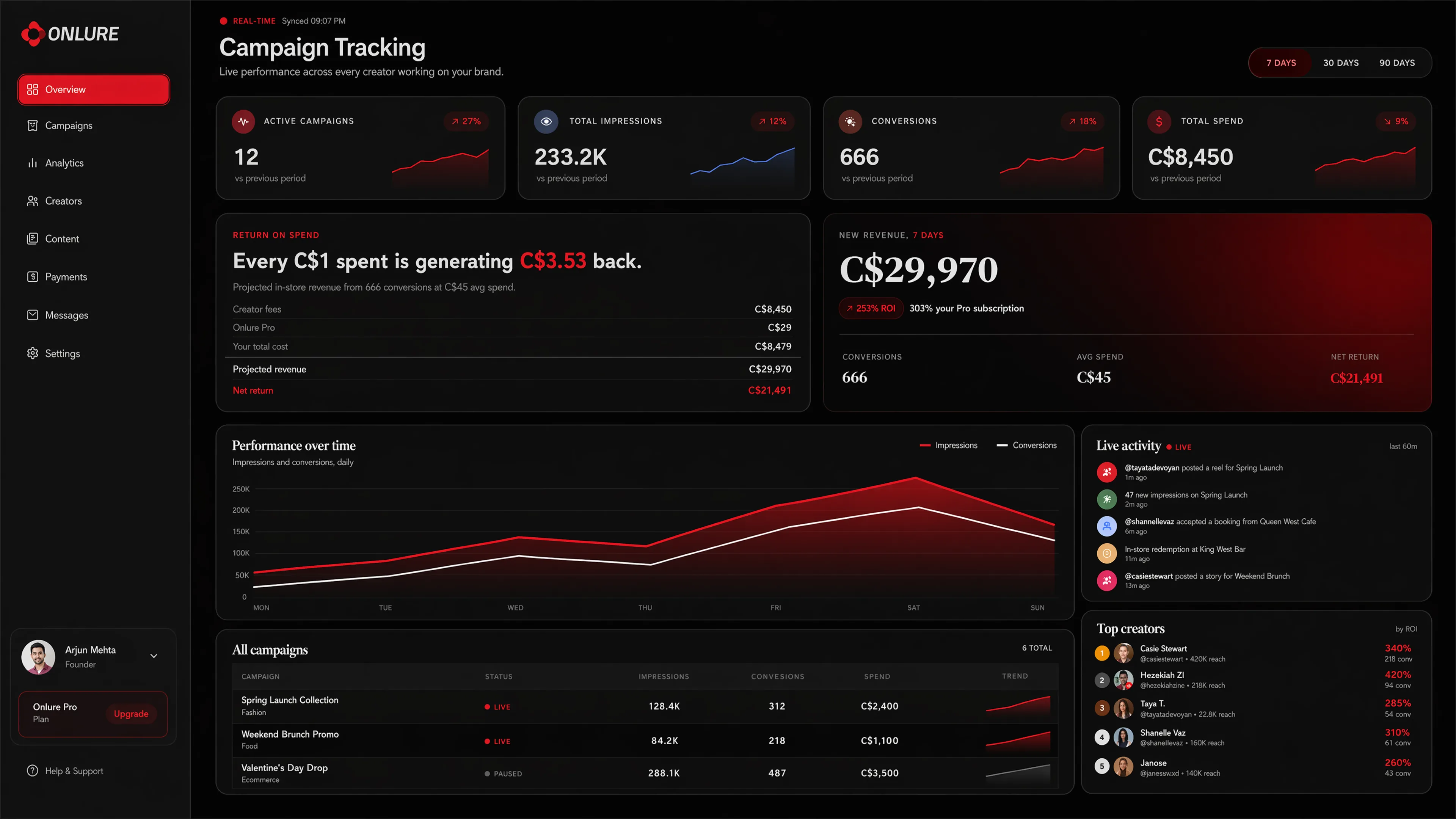
Half of marketing leaders now name ROI/ROAS measurement as their single biggest influencer-marketing challenge (Later, 2026). The gap is real.
What "closing the loop" actually requires
To tie a specific creator to a specific in-store visit, you need a moment of deterministic capture at the door. A scan or a booking event that says "this person came from this creator," not a model that says "probably."
That's the gap Onlure is built around. Collaborations get booked through the platform, so the link between a creator and a campaign is explicit from the start. You don't reconstruct it after the fact from decaying signals.
“Promo codes and UTM links were built for clicks. Foot traffic needs a different instrument entirely.”
The takeaway for local brands
If your attribution still depends on cookies or "link in bio," assume it under-counts your in-person results. The brands that win in 2026 are the ones measuring verified visits, not impressions.