A $1,000 creator booking in Canada in 2026 sits right at the median for local SMB creator marketing. It's small enough to test without sweating the loss, big enough to attract creators who are actually good, and shaped to deliver measurable results inside 14 days. Below is exactly what a $1,000 booking looks like: what the brand pays for, what the creator delivers, what the platform takes, and what the ROI runs at the median.
Most SMBs reading "creator marketing" content have no concrete sense of what $1,000 actually buys. One post? Three? A month-long ambassador deal? Without that picture, the budget never clears.
So here are the actual line items of a $1,000 booking in Canada in 2026. The averages, the ranges, what's negotiable, and what the brand walks away with.
1. What does $1,000 buy in Canada in 2026?
The most common $1,000 booking shape:
- 1 Instagram Reel (30 to 60 seconds)
- 2 to 3 Instagram Stories during the visit
- 1 cross-post to TikTok (treated as bonus, not a separate fee)
- An in-person visit lasting 60 to 90 minutes
- Posting within 7 days of the visit
- Tagging the brand and using the agreed-on offer code
This package targets a creator with 5K to 15K Instagram followers, mostly concentrated in one Toronto neighborhood. If the creator has 30K+, the package shrinks to just the Reel, or the rate climbs.
2. How does the $1,000 break down by creator tier?
Same budget, different shapes depending on creator size.
Nano (under 1K followers): $1,000 = 4 to 6 bookings
- Each booking $150 to $250
- Best for testing what works before you scale
- Often hyper-local, tied to one neighborhood
Nano-Micro (1K to 5K followers): $1,000 = 3 to 4 bookings
- Each booking $200 to $400
- Best for small business launches and seasonal pushes
- Strong engagement rates, tight local concentration
Micro (5K to 15K followers): $1,000 = 2 to 3 bookings
- Each booking $300 to $500
- Best for established brands that want predictable mid-tier reach
- Solid balance of reach and engagement
Lower-Mid (15K to 50K followers): $1,000 = 1 to 2 bookings
- Each booking $500 to $1,000
- Best for credibility plays or signature campaigns
- Lower engagement rates, bigger initial reach
Mid-Tier (50K+ followers): $1,000 = 1 booking with reduced scope
- Often Stories-only or a single Reel
- Best for brand awareness pushes
The "right" tier follows the campaign goal. Want foot traffic in a specific neighborhood? Go nano or nano-micro. Want brand awareness across the city? Micro or lower-mid. Building credibility or launching something? Lower-mid or mid-tier.
3. What does the brand actually receive?
Beyond the post, a $1,000 booking includes (or should include):
- Editorial control: the creator owns the creative, the brand provides the brief
- Posting commitment: the post goes live within 7 days
- Hashtag and tagging: brand handle plus agreed hashtag
- Story coverage: 2 to 3 Stories during or shortly after the visit
- Performance reporting: screenshots of post insights at 24 hours and 7 days
- Re-post rights for the brand's organic channels (no paid amplification unless licensed)
Optional add-ons that usually cost extra:
- Paid amplification rights (typical add: 25% to 50% of base for 30 days)
- Cross-platform exclusive posting
- Multi-post ambassador commitment
- Specific creative directions (a particular dish, a particular shot)
- An edited "brand cut" of the content
4. What does the creator actually do?
A typical creator workflow for a $1,000 booking:
- Pre-visit (30 to 60 minutes): read the brief, confirm the visit window, plan the shot list, scout the location if needed
- Visit (60 to 90 minutes): arrive, capture content (B-roll, Reels footage, Stories in real time), interact with the brand if planned
- Post-visit editing (2 to 4 hours): assemble the Reel, cut for hook and pacing and length, write the caption, draft Stories
- Posting (15 to 30 minutes): upload, tag, hashtag, add the link sticker for Stories
- Engagement (30 to 60 minutes spread over 48 hours): answer DMs and comments, engage with the brand's repost
- Reporting (15 to 30 minutes): screenshot post insights, send to the brand
Total time: roughly 5 to 8 hours per booking. At $1,000, that works out to $125 to $200 per hour. Fair pay for a creator who's spent years building an audience.
5. Where does the money actually go?
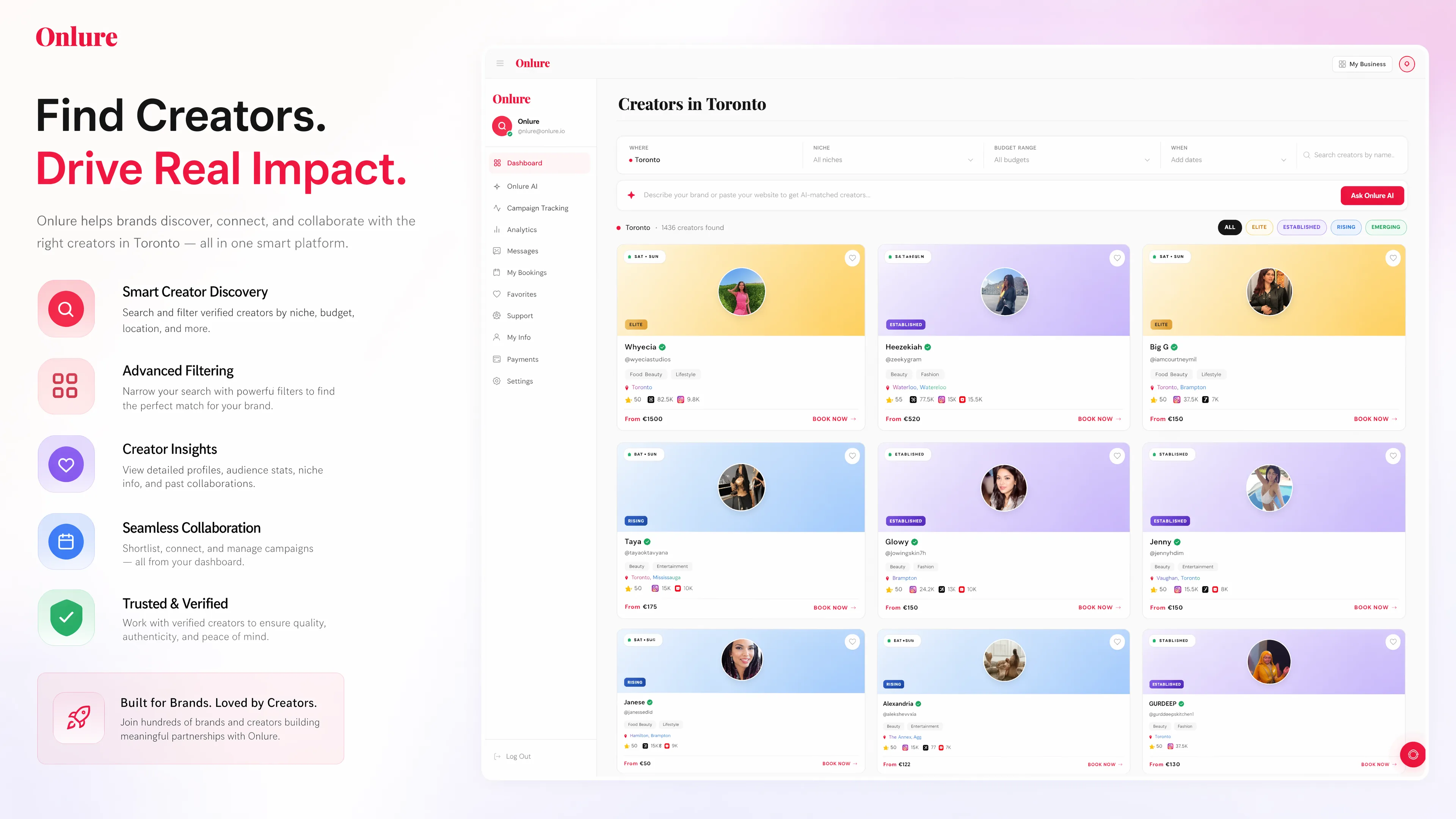
For a $1,000 booking on a structured platform like Onlure:
- Creator receives the full $1,000 (no commission cut)
- Brand pays a small platform fee (1.5% insurance/processing, depending on payment method)
- Total brand cost: roughly $1,015 to $1,030
Now compare a traditional agency-managed booking:
- Creator typically receives: $700 to $850 (15% to 30% taken by the agency)
- Brand pays: $1,000 plus agency fees
- Effective hourly rate to creator: $87 to $170 (versus $125 to $200 on direct platforms)
That gap is the whole reason direct creator marketplaces have pulled in so much volume. The creator-side economics run 20% to 30% better.
6. What ROI does a typical $1,000 booking generate?
Based on Onlure platform data across hundreds of bookings:
- Median in-store visits driven per $1,000 booking: 25 to 60 (depending on niche, location, and time of year)
- Median cost per measured visit: $17 to $40
- Median Reel views (combined first 14 days): 8,000 to 35,000
- Median Story views: 1,500 to 6,000
The ROI swings hard on four things:
- Whether you have a unique offer code or QR. Without it, attribution is partial and the ROI reads smaller than it really is.
- Whether the creator's audience is local to the brand's location
- Whether the creator's niche lines up with what the brand sells
- Whether the brief was specific or vague
7. When should I spend more than $1,000 on a single creator?
Three cases where a $1,500 to $3,500 booking earns its keep.
Scenario one: signature seasonal launch. A new menu, a grand opening, a seasonal campaign. Worth tiering up to a 15K to 50K follower creator.
Scenario two: ambassador-style deal. Book the same creator for 3 to 4 posts over 60 days. The per-post cost drops and the cumulative impact compounds.
Scenario three: licensed paid amplification. $1,000 for the booking plus $500 to $1,000 for the right to run the Reel as a paid ad for 90 days. Best for brands that already have working ads and want better-converting creative.
For most SMBs running their first 5 creator campaigns, stay in the $300 to $1,000 per booking range. Test, learn, then put more money behind what actually works.
8. What's the right cadence at the $1,000 level?
If your monthly creator marketing budget is $3,000 to $5,000:
- 3 to 5 creator bookings per month at $300 to $1,000 each
- Mix nano, nano-micro, and micro
- Test 2 to 3 different formats (Reel, TikTok, Story-only)
- Track which one converts best for your business
By month 3, you have data. By month 6, you have a channel you can run again and again.
Start with one $300 booking
You don't need to open at $1,000. A first $300 booking with a hyper-local nano creator is enough to learn the channel, test your brief framework, and decide whether any of this works for your business.
Onlure brand profiles let you book your first creator in under 5 minutes.