Five shifts have reshaped creator marketing in the first half of 2026. Brands have moved budget from mega creators to nano and micro faster than anyone forecast. Better measurement has become a real demand. Content licensing has gone from optional to standard. Local has beaten national in measured ROI. AI matchmaking has compressed the discovery cycle from weeks to minutes. Here's what changed and what comes next.
The first half of 2026 has been the most volatile six months in creator marketing since the iOS 14 attribution change in 2021. Five distinct shifts have reshaped what brands buy, what creators sell, and how the value flows.
This post is the spring 2026 industry update. What changed since January, why it matters, and what the next 6 months look like.
Shift one: The mega creator collapse
For 8 years, the assumption was that bigger creators commanded bigger budgets. That assumption is breaking, fast.
Top-tier brand spend (defined as creators with 1M+ followers) has dropped 18% year over year in Canada. Spend on creators with 1K to 100K followers is up 41% year over year. The reallocation has happened on a faster timeline than anyone predicted in late 2024.
Three reasons:
- Mega creator engagement has fallen below 1% on Instagram for most major accounts
- Better measurement has shown brands what nano and micro creators actually deliver
- Mega creator deal complexity (agencies, lawyers, exclusivity clauses) has not gotten simpler while smaller deals have
That adds up to a structural reallocation of roughly $400M in Canadian creator spend from mega to micro in 18 months, and most of it happened invisibly: brands rebalanced quietly while mega creators noticed slowly.
So agencies built around mega creators are in trouble, and platforms built around the long tail of nano and micro creators are growing fast.
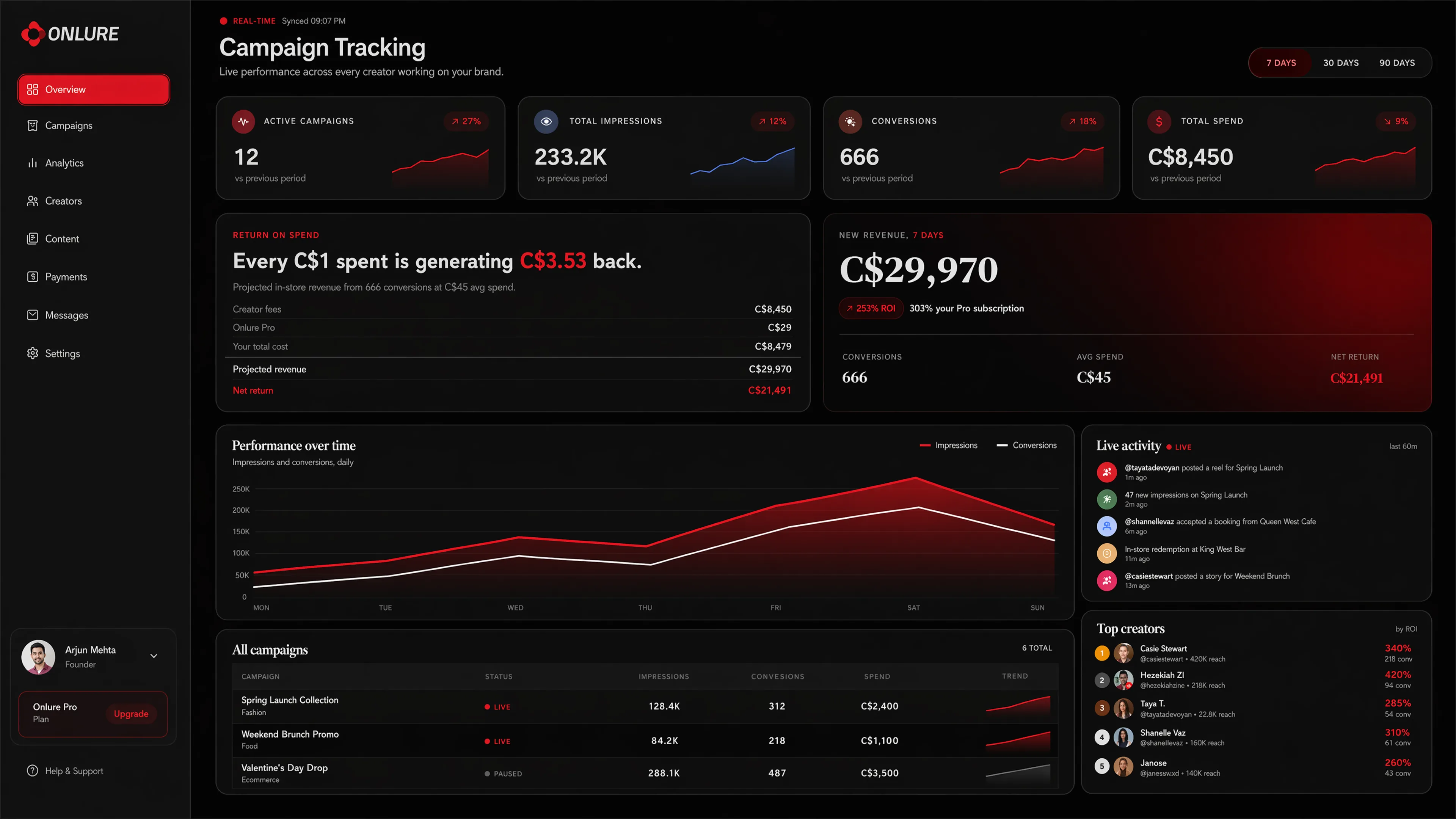
Shift two: Better measurement is now table stakes
Six months ago, "better creator measurement" was a feature pitched by a few platforms. Today, it is a demand in most brand briefs.
The CMO of a Toronto restaurant group told us in March: "I will not approve a creator marketing line item without a clear path to measurable visits. The era of 'we did some Reels and revenue went up' is over."
This is the structural shift in how brands think about creator marketing. The channel was previously evaluated on the same vibes-based framework as PR (impressions, reach, sentiment). It is now evaluated on the same hard-data framework as paid acquisition (cost per acquired customer, lifetime value, return on ad spend).
For creators, this is double-edged. Creators who deliver measurable outcomes will see rates rise. Creators whose value was based on vanity metrics (follower count, vibe) will see budgets shrink. The reweighting is already visible in platform data.
For platforms, measurement is the moat. Platforms that can connect "this creator drove this customer" credibly will absorb the spend. Platforms that cannot will lose share.
Shift three: Long-form content licensing becomes the default
Two years ago, content licensing was a separate negotiation that most creators forgot to ask for. In Q1 and Q2 2026, it has become a default line item in standard creator deal structures.
Brands have learned that the highest-converting Instagram and TikTok ads are repurposed creator content. Pre-made creative from creators outperforms custom-shot brand creative by 2x to 4x in click-through rates. Brands need licensing rights to run the creator content as ads. Creators have figured out they can charge for those rights.
Standard licensing add-ons in Canada in spring 2026:
- Paid social amplification, 30 days: 25% to 50% of base creator fee
- Paid social, 90 days: 50% to 100% of base
- Full digital usage, 90 days: 75% to 150% of base
- Full commercial usage, 12 months: 200% to 500% of base
Creators who add licensing as a standard line item are seeing total deal sizes grow 30% to 80% over the same booking cadence as 2024. This is one of the most significant pricing shifts in the channel. Brands will increasingly negotiate 30 to 90 day usage rights upfront rather than treat licensing as a 25% afterthought add-on. Adoption roughly doubles by Q4.
Shift four: Local has decisively beaten national in measured ROI
The thesis that local creators outperform national creators for local businesses has been argued for years. In spring 2026, the data settled the argument.
The most-cited numbers from Q1 platform data across Onlure and similar platforms:
- Creators within 5km of a brand drive 3.4x the in-store visit rate of creators outside 5km, with follower count controlled
- 70% to 85% of nano creators' followers are in the same city, vs 20% to 35% for national creators
- Local creators drive 64% higher save rates on Reels for local businesses, vs national creators
- Local creators have 6 to 9x higher inbound DM rates from local consumers
For any local brand, the right answer is local creators with hyper-concentrated audiences who already walk past your store. National creators with better content and regional creators with bigger reach both lose to that.
This shifts strategy meaningfully. Brands that historically searched for "Canadian beauty creators" are now searching for "Toronto Yorkville beauty creators." The geographic specificity has gone up by an order of magnitude.
Shift five: AI matchmaking compressed the discovery cycle
The pre-2025 process of finding a creator: scroll Instagram for hours, save profiles to a spreadsheet, send 30 cold DMs, get 4 responses, schedule 2 calls, book 1 creator. Total elapsed time: 2 to 3 weeks.
The 2026 process on AI-matched platforms: describe your business, see a curated shortlist within 30 seconds, message your top 3, book 1 within 48 hours. Total elapsed time: 1 to 3 days.
This 10x compression in discovery time has more downstream effects than most realize:
- Brands run more campaigns per year because each one takes less effort
- Creators get more inbound from brands they would never have found otherwise
- The creator middle class (covered in our recent post) becomes accessible
- Spontaneous campaigns become possible (a brand can launch a "this weekend only" creator push on Tuesday)
The compression has also made creator marketing a real-time channel for the first time. Pre-AI matching, creator campaigns took weeks to launch. Now they can launch in days. That changes the strategic toolkit.
What's next: The summer 2026 outlook
Five predictions for the next 6 months:
Prediction one: Patio and event season pushes will hit record creator spend. With patio season opening in May and outdoor events ramping into summer, restaurants and venues will book creator campaigns at 1.4x to 1.8x the rate of summer 2025.
Prediction two: TikTok grows fastest in CAD spend. TikTok creator marketing spend in Canada will grow 35% to 50% in H2 2026, narrowing the gap with Instagram.
Prediction three: First "creator-only" venues start appearing. Toronto will see the first restaurants and venues that explicitly position themselves around creator content (purpose-built lighting, designated content corners, partnered creator programs). Already in early form. Expect 5 to 10 venues by Q4.
Prediction four: Mega creator rates start falling. With brand budgets reallocating, mega creator rates will drop 10% to 20% by year end. Some agencies will close. The market will normalize around micro and nano as the high-value tier.
Prediction five: Ambassador-style monthly retainers replace one-off bookings for top brand-creator pairs. Brands that find a creator who consistently delivers will lock in 3 to 6 month recurring contracts at a 10% to 20% discount in exchange for guaranteed cadence. Adoption roughly triples by Q4.
What this means for brands
If you are a brand reading this and you are not booking creators yet, the gap between you and your competitors is widening every month. The cost of catching up gets higher every quarter.
The right move is to start small (one or two creators, $400 to $800 spend), apply the 90-day framework, and have a working channel by the end of summer.
What this means for creators
If you are a creator with 1K to 50K followers and you are not on a structured platform charging fair-market rates with licensing add-ons, you are leaving 30% to 80% of your potential revenue on the table.
The market shifts in 2026 favor middle class creators who package themselves correctly. Claim profiles, set rate floors, charge for licensing, and stop accepting deals that undervalue your audience.
Stay ahead of the next shift
Onlure tracks the changes in real time. Brand profiles surface trending creators. Creator profiles surface trending niches. The platform reflects the market.