You don't need 1,000 followers to land your first paid brand deal in 2026. You need a clear niche, three pieces of strong recent content, and a discoverable profile on a platform local brands actually use. Some Onlure creators have landed paid bookings under 500 followers. Here's the exact path from zero to first paid deal in 30 to 60 days, no follower minimum, no agency.
The biggest myth in creator marketing is that brands won't pay you until you hit 10,000 followers. Or 50,000. Or 100,000. That was true in 2018. It stopped being true years ago.
The brands that pay best for nano content (1K and below) are local small businesses, and here's why. A 500-follower creator with a sharp niche and a tight neighborhood focus drives more in-store visits per dollar than a 50,000-follower creator with a national audience. The math just works in your favor.
So this is the playbook for going from zero to first paid deal. Real, doable, in 30 to 60 days.
1. Can I really get paid with under 1,000 followers?
Yes. Onlure platform data: 14% of paid creator bookings in Q1 2026 went to creators with under 1,000 followers. Average rate for this tier runs $80 to $250 per Reel or Story package. Smaller numbers than a micro creator earns, sure, but it's real money landing in real accounts.
Here's why brands book sub-1K creators:
- Higher engagement rates (often 8% to 15% on Reels)
- Higher local concentration (sometimes 90%+ of followers in the city)
- Lower rates, so brands can test you without taking on risk
- An authenticity premium, because the post doesn't read as paid
The brands hiring you at this tier tend to be small: a 1 to 5 location restaurant, a single-location boutique, the cafe down the street. They're also the brands most likely to stick with you as you both grow. Land one well and you've often got a repeat client, not a one-off.
2. What does my profile need to land my first deal?
Five things, in order of importance.
One: a clear niche stated in your bio. "Toronto creator" tells a brand nothing. "Kensington food finds" tells them everything. Brands match on niche, and a vague niche matches nobody.
Two: 9 to 12 recent posts that all match the niche. Brands check your last grid before they book. If half your recent content is off-niche, the booking quietly doesn't happen and you never find out why.
Three: location stated in your bio. "Based in Toronto" works. "Toronto, Junction neighborhood" works better. A brand 5km away will never find you if your bio doesn't say where you are.
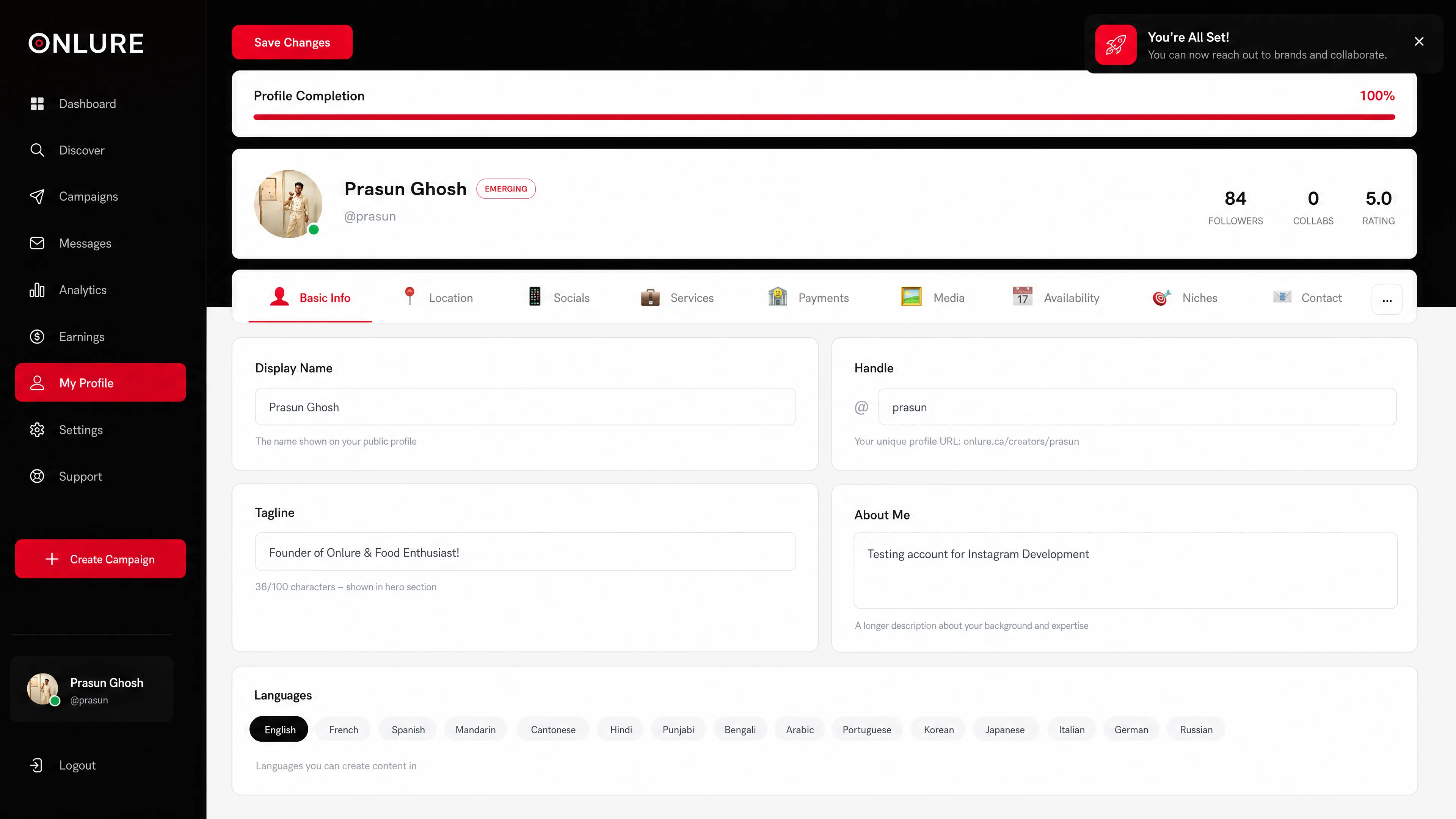
Four: a contact method. Either a creator platform profile (Onlure, etc.) or a clear "DM for collabs" line. Brands won't chase you down. Make it one tap.
Five: a one-page media kit. Once you've got 5 to 8 sample posts, put them on a single page with your niche, audience demographics, follower count, engagement rate, and rates. The templates are free. That one page closes deals at twice the rate of "DM me for info."
3. How do I pick a niche when I have no audience yet?
Here's the niche-picking framework that works for new creators.
Step one: list 5 things you do or like that are specific to your city. "Toronto coffee," "Toronto vintage," "GTA running routes," "Asian beauty in Toronto," "Downtown Toronto rooftops." Tie each one to the city. Skip the generic interests.
Step two: cross out the saturated ones. Search each niche on Instagram. If 50+ established Toronto creators already own it with 20K+ followers, that lane is full. Pick something less crowded.
Step three: pick the niche where your knowledge or access is highest. Live in the Junction? "Junction food finds" beats "Toronto food" every time, because your geographic edge is genuine and you can't fake it.
Step four: commit for 90 days. A new niche needs 30 to 50 posts before it starts ranking. Don't bail at day 14 because growth feels slow. It always feels slow early.
The biggest mistake new creators make is going too broad. "Toronto" is too broad. "Toronto food" is still too broad. "Toronto brunch in the east end" is the sweet spot.
4. What kind of content should I post in my first 30 days?
This is the content mix that builds a discoverable nano profile:
- 3 Reels per week (these drive most of your discovery)
- 2 Stories per week (these build the relationship with people already following you)
- 1 carousel post per week (these get saved, which signals engagement quality to brands)
Every post fits the niche. If your niche is "Junction food finds," every post is a Junction food spot. Not your dog. Not your gym. Not your trip to Banff. Those belong on a personal account.
The single highest-performing format for nano food creators in Toronto in 2026 looks like this:
- 15 to 30 second Reel
- Wide shot of the spot exterior
- Close shot of the hero menu item
- One sentence of overlay text with the location and the hook
- Trending audio
- Caption with the spot name, address, and a one-line review
Run that format 12 times. Around post 8 or 9, the algorithm starts surfacing you to neighborhood viewers. By post 12 you're landing in "for you" feeds across your area. That's the moment brands find you.
5. How do I get on a brand's radar without them having found me organically?
Three tactics that work, in order of effectiveness.
Tactic one: claim a profile on a creator platform brands already use. Nothing else moves the needle this fast. On Onlure, brands actively browse and search for nano creators in specific neighborhoods, so the platform does the discovery work for you. Your profile shows up in brand searches at 200 followers, as long as your niche and location are clear.
Tactic two: tag local brands in genuinely good content. Not "I love this place!!" with a tag slapped on. Real content the brand would be proud to repost. They repost, their audience sees you, you grow. That's the whole loop.
Tactic three: send a warm DM, not a cold pitch. A warm DM sounds like "Hey, came in last Tuesday and loved [specific dish]. Posted a Reel here [link]. Would love to do a more intentional content piece if you ever do creator collabs." A cold pitch sounds like "Hey, I'm a content creator, here's my rate sheet." The first converts at 8% to 15%. The second converts at 1% to 3%. Same effort, wildly different result.
6. What should I charge for my first paid deal?
Here are the rates that work for sub-1K creators in Toronto in 2026:
- First paid Story: $50 to $120
- First paid Reel: $100 to $250
- First paid in-store visit + content bundle: $150 to $400
Don't undercut yourself. The first rate you charge anchors every deal you negotiate after it. Price your first deal at $30 and you'll spend 12 months climbing out of that hole. Price it at $150 and your fifth deal is $300, your tenth is $500. The slope is everything.
If a brand pushes back on your starting rate, you've got two clean responses.
"Happy to discuss. My rate reflects the fact that my audience is concentrated in [specific neighborhood], which is where most of your foot traffic comes from. Would you like to lock in a 3-campaign rate at a 15% discount?"
Or:
"I understand. This rate is firm for individual campaigns. If you want to start lower, I have a 'first collab' rate of $X for new brand relationships, with the understanding that the next campaign moves to my standard rate."
Both hold your value and still hand the brand a way forward.
Start the path today
Claim your Onlure creator profile, set your niche, link your social accounts, and you'll start showing up in brand searches the same week. Most creators land their first inquiry within 14 days of finishing a profile.