
Toronto's patio season runs roughly 14 weeks from mid-May to early September and accounts for 38% to 52% of annual revenue for most patio-equipped restaurants and cafes. The brands that book creators in May win the season. Brands that wait until July are competing for whatever creator slots are left, often at 1.5x to 2x peak rates. Here's the patio playbook: when to book, who to book, what to brief, and how to convert summer foot traffic into year-round customers.
If you run a restaurant or cafe with a patio in Toronto, the next 14 weeks decide your year. We've seen it across the platform: brands that lock in their summer creator calendar before May 15 outperform brands that wait by 3x to 4x in measured foot traffic. The reason is supply.
This is the patio season playbook for 2026. Specific, time-bound, and built around what's worked across active campaigns this spring.
1. When does Toronto's patio season actually start?
Most Toronto patios open the second week of May. The real volume kicks in around Victoria Day weekend (May 18 this year) and peaks from late June through mid-August. Volume drops sharply after Labour Day weekend.
The booking calendar that wins:
- Now to May 15: lock in your top-tier creators for the season. Their availability is at its widest right now.
- May 15 to June 1: book mid-tier creators for opening weekends.
- June 1 to July 15: book in-the-moment creators for special menus, events, and weekend pushes.
- July 15 onward: rates have risen, top creators are booked solid, you are competing for backup slots.
The brands that move first this month pay 2026 spring rates and lock in availability. Brands that wait until July are paying summer-peak rates with limited choice.
2. What kind of creator drives the most patio foot traffic?
Three creator profiles dominate patio season conversion based on Onlure platform data from 2025:
Profile one: the local food creator with 3K to 10K followers, focused on a specific neighborhood. Their followers live within 5km. When they post a patio shot, the conversion to in-person visit is the highest of any creator type for restaurants. Average rate: $200 to $500 per post.
Profile two: the Toronto lifestyle creator with 8K to 30K followers who covers multiple categories (food, drink, weekend activities, dating spots). Their content frames a patio as a destination, not a meal. Best for date-night positioning. Average rate: $400 to $900 per post.
Profile three: the cocktail or beverage creator with 5K to 20K followers. If your patio has a strong drink menu, this profile drives the highest spend per visitor. Cocktail content gets saved at higher rates than food content. Average rate: $300 to $700 per post.
Mix all three across the season. Don't book the same profile every weekend.
3. What do I include in a patio season creator brief?
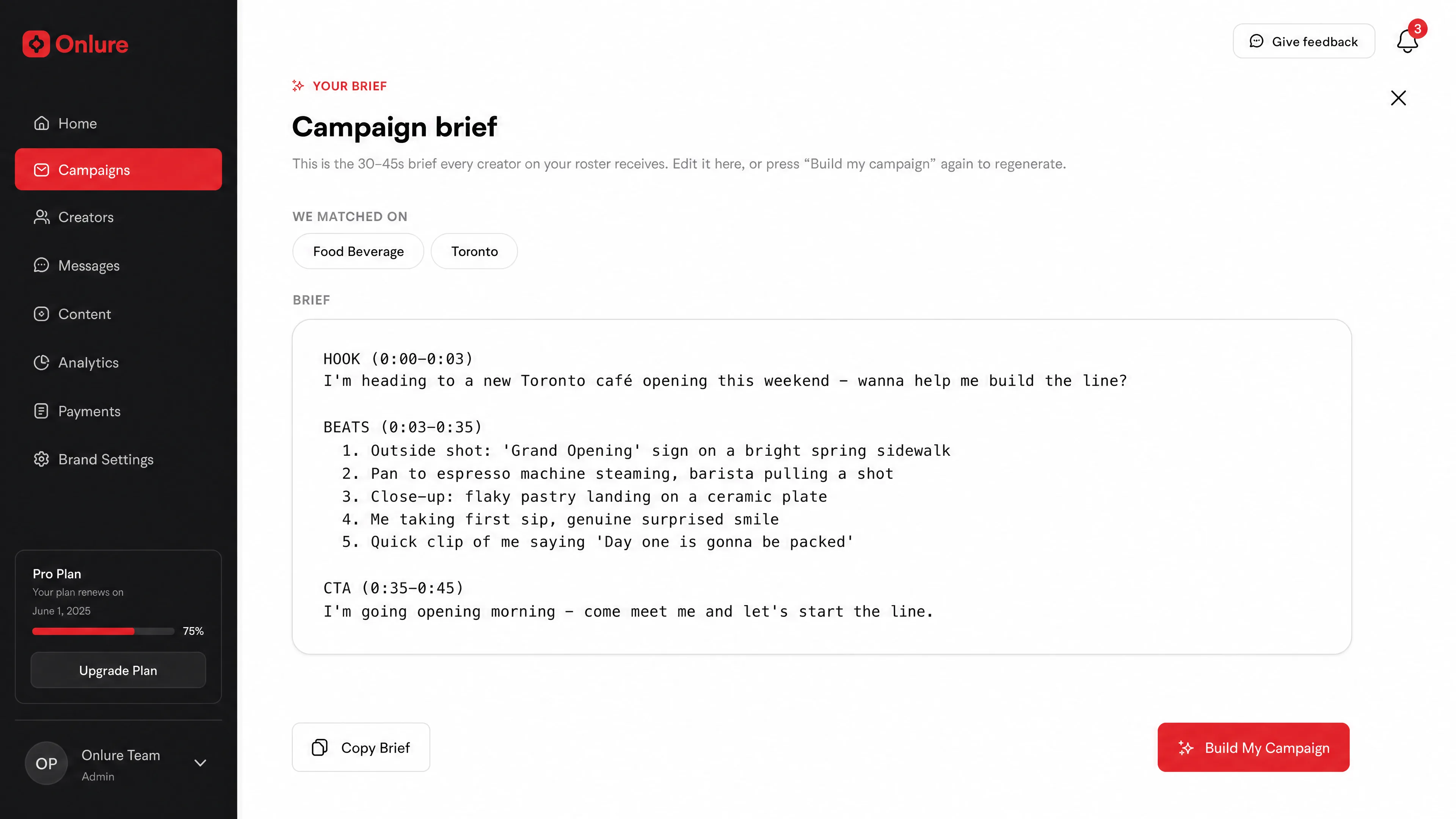
The patio brief that converts has six elements. Skip any of them and the campaign underperforms.
One: the visit window. Specify the date range, day of week, and time of day. "Anytime in June" converts at half the rate of "Saturday or Sunday afternoon between 1pm and 4pm during the first two weeks of June."
Two: the hero menu item. Tell the creator what to order and feature. Patio-season menus often include items that are not on the regular menu. Make this clear.
Three: the angle. "Best new patio in Leslieville" is a different post than "Where to take a first date this summer." Pick the angle. Otherwise the creator picks one and it might not be yours.
Four: the wide shot. Patio content is visual. Tell the creator you want at least one wide shot of the patio in addition to the food shots. This is the asset that goes viral.
Five: the location tag and handle. Make sure the creator tags both the geo-location and your handle. Sounds obvious. Half of bad campaigns skip this.
Six: the "what makes this different" line. Give the creator one sentence about what makes your patio different from the other 1,800 patios in Toronto. Heated? Pet-friendly? Rooftop? Tucked away? Specific drink menu? This is what they will quote in their caption.
4. How do I convert summer foot traffic into year-round customers?
Patio season delivers a one-time spike. Year-round revenue requires capturing those customers before they leave.
Three tactics that convert summer one-timers into recurring customers:
One: the "summer to fall" follow-up offer. Anyone who visits between May and August gets an offer for a fall return visit. Send through email or SMS at the end of August. Conversion rate to second visit: 18% to 26% in our data.
Two: the seasonal email capture. Add a low-friction email capture at the patio host stand or on the bill. Promise something in return (a free drink on next visit, an early-access menu drop). Capture 20% to 35% of summer visitors.
Three: the creator-driven follow-up. Re-book the creators who drove the most summer visits to do a "fall favorites" round in October. The audience already trusts them and already knows your spot. Re-engagement campaigns convert at 2.4x the rate of cold campaigns.
5. What patio-specific mistakes do most restaurants make?
Five mistakes we see every May:
Mistake one: booking only one creator. A single Reel is noise. Three coordinated Reels across two weeks is signal. Book in batches of three minimum.
Mistake two: scheduling creator visits during peak hours. Creators need space to film. Saturday at 7pm gets you bad content. Saturday at 2pm or Tuesday at 6pm gets you great content.
Mistake three: not coordinating with FOH. The host needs to know the creator is coming. Otherwise the creator waits 40 minutes for a table and the experience shows up in the post.
Mistake four: skipping content licensing. A great patio Reel from June can run as your top-converting Instagram ad in July, August, and September. Negotiate licensing upfront. The math is overwhelming.
Mistake five: not tracking visits. Every patio campaign should have a redemption mechanism (discount code, signature drink, free dessert with mention). Otherwise you have no way to attribute the visit and you cannot judge whether the campaign worked.
6. What is the right summer budget for a Toronto patio?
The benchmark for a small to medium Toronto restaurant or cafe with a patio:
- Tier one (small budget, $1,500 to $3,000 total): 4 to 6 nano creator bookings spread across May, June, July. Best for new spots building neighborhood awareness.
- Tier two (medium budget, $3,000 to $7,000): 8 to 12 mixed nano and micro bookings, plus content licensing on top performers. Best for established spots looking to scale.
- Tier three (premium budget, $7,000 to $15,000): 12 to 20 bookings across nano, micro, and one mid-tier creator for a feature, plus content licensing and ambassador-style monthly drops. Best for spots competing in saturated neighborhoods.
The biggest mistake at every tier: spending the whole budget in May. Spread across the season so you have momentum in August when most competitors have run out of budget.
Lock in your patio creator calendar
Browse Toronto food, drink, and lifestyle creators on Onlure and book your first three creators of the season this week. Top creator availability shrinks every week from now through June.